
Gear Ratios and Regearing Larger Tires: The Truck Owner's Math Guide
Larger tires make your truck’s axle ratio act numerically lower. That is why a truck that felt fine on 32-inch factory tires can feel lazy on 35s or 37s. The engine has less mechanical leverage at the ground, the transmission may hunt more often, and the speedometer can read low unless it is recalibrated.
The quick math is simple:
effective ratio = current axle ratio x old tire diameter / new tire diameter
restore-stock-feel ratio = current axle ratio x new tire diameter / old tire diameter
For example, a truck with 3.73 gears moving from a 32-inch tire to a 35-inch tire now behaves roughly like it has 3.41 gears. To restore the original mechanical relationship, the math points to about 4.08, so a common nearby axle ratio would be 4.10.
Key Takeaways
- Going from 32s to 35s is often where drivers start noticing lazy starts, more downshifts, and softer towing feel.
- Regearing is not required for every tire upgrade. Mild changes may only need speedometer calibration.
- The restore-stock-feel formula is a starting point, not the final answer. Towing, transmission gearing, engine torque, terrain, and fuel economy goals matter.
- Four-wheel-drive trucks generally need matching front and rear gear changes if the axle ratio is changed.
- Differential setup is precision work. Backlash, pinion depth, bearing preload, gear pattern, and break-in matter.
- We checked the math against public drivetrain calculators and manufacturer technical guidance. We did not perform a differential install.
Quick Answer
If your new tires are only one size taller, recalibrate the speedometer and drive the truck before spending regear money. If you jumped from roughly 32s to 35s, tow often, carry a topper or tools, drive hills, or feel constant transmission hunting, regearing becomes worth pricing. If you jumped to 37s on a half-ton or midsize truck, expect gearing to be part of the real build plan.
| Tire Change | What Usually Happens | Regear Direction |
|---|---|---|
| 31.5 to 33 inches | Mild speedometer error, slight softness | Calibrate first, regear only if towing/off-road demands it |
| 32 to 35 inches | Noticeable effective-ratio drop | Often worth comparing 4.10, 4.56, or platform-specific options |
| 32 to 37 inches | Big drop in leverage and shift behavior | Regear is commonly part of a properly sorted build |
| Heavy mud tires plus wheels | Extra rotating/unsprung mass | Regear and shocks may both enter the conversation |
| Tow rig with larger tires | More heat, more downshifts, softer launch | Price gears before blaming the transmission |
Yukon Gear’s technical resources note that tire size, transmission ratio, cruising RPM, stock gear ratio, and intended use all matter, and that larger tires change final drive behavior because tire circumference changes: Yukon Gear technical tools.
Start With Tire Size and Speedometer Calibration
Before you think about ring-and-pinion gears, make sure the truck knows its tire size if the platform allows it. Taller tires travel farther per revolution, so the speedometer and odometer can be wrong.
NHTSA tells drivers to use the owner’s manual or Tire and Loading Information label for correct tire size, and to use manufacturer-recommended sizes when maintaining tire safety: NHTSA TireWise. If you deliberately move away from the original tire size, use that as a reminder to check load rating, pressure, rubbing, braking, and calibration, not only the visual stance.
Speedometer calibration may be enough when:
- The tire change is modest.
- The truck still accelerates and shifts normally.
- You do not tow near the truck’s ratings.
- Highway RPM is still comfortable.
- Transmission temperature stays normal.
If you own a supported GM, Ford, or Ram truck, start with the make-specific calibration guide:
- Chevy/GMC larger-tire speedometer calibration
- Ford F-150 larger-tire speedometer calibration
- Ram larger-tire speedometer calibration
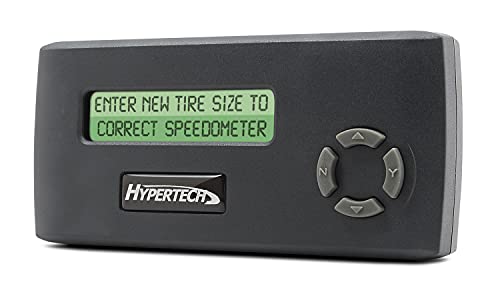
Hypertech Speedometer Calibrator Example
- • Calibration-tool example
- • Often used for tire-size and speedometer correction on supported vehicles
- • Compatibility varies heavily by year and powertrain
- • Check current fitment before buying

Superchips Flashcal Example
- • Tire-size calibration and vehicle-setup tool example
- • Commonly compared for supported Ford/Ram/Jeep-style applications
- • May offer functions beyond speed correction
- • Confirm exact vehicle support
The Core Gear Ratio Formula
The restore-stock-feel shortcut is:
new axle ratio = old axle ratio x new tire diameter / old tire diameterUse measured tire diameter when you can. A tire sold as a 35 may measure closer to 34.5 inches mounted and loaded, and manufacturer specs can vary by size, wheel width, and inflation.
| Old Ratio | Old Tire | New Tire | Effective Ratio After Tire Change | Ratio That Restores Stock Feel |
|---|---|---|---|---|
| 3.73 | 32.0 in | 35.0 in | 3.41 | 4.08 |
| 3.55 | 31.5 in | 35.0 in | 3.19 | 3.94 |
| 3.92 | 32.0 in | 37.0 in | 3.39 | 4.53 |
| 4.10 | 33.0 in | 37.0 in | 3.66 | 4.60 |
That table does not mean every truck should pick the nearest number. It means the math has shown you the baseline. From there:
- Pick the nearest available ratio if you want the stock feel back.
- Pick a deeper ratio if towing, off-road crawling, hills, and heavy tires matter more than low highway RPM.
- Pick a milder ratio if highway fuel economy and noise matter more than launch feel.
- Ask a drivetrain shop what ratios are actually available for your axle.
Yukon’s public RPM calculator and Spicer’s RPM calculator both use the same relationship between tire height, axle ratio, vehicle speed, and engine RPM: Yukon RPM calculator and Spicer RPM calculator.
RPM Examples at 65 MPH
The common estimate is:
engine rpm = mph x axle ratio x transmission top gear ratio x 336 / tire diameterThese examples assume a 0.67 overdrive ratio, which is only a sample number. Use your truck’s actual top gear ratio for real planning.
| Setup | Estimated RPM at 65 MPH |
|---|---|
| 3.73 gears, 32-inch tire, 0.67 overdrive | 1,706 rpm |
| 3.73 gears, 35-inch tire, 0.67 overdrive | 1,559 rpm |
| 4.10 gears, 35-inch tire, 0.67 overdrive | 1,714 rpm |
| 3.92 gears, 37-inch tire, 0.67 overdrive | 1,550 rpm |
| 4.56 gears, 37-inch tire, 0.67 overdrive | 1,803 rpm |
The first three rows show why 4.10 can make sense after moving from 32s to 35s on a 3.73 truck. It puts cruise RPM close to the original relationship. The 37-inch examples show why a 3.92 truck can feel surprisingly tall after big tires, and why a deeper ratio may make the truck feel more normal again.
When Regearing Is Worth It
Regearing is expensive because it is precision drivetrain work, not because the ring-and-pinion set is mysterious. It makes sense when the tire change has moved the truck outside its happy operating range.
Signs you should price a regear:
- The truck constantly downshifts on mild grades.
- First gear feels too tall when pulling away.
- Towing feels hotter, slower, or busier than before.
- The transmission hunts between gears on the highway.
- You added heavy mud tires, steel wheels, armor, a topper, or a bed rack.
- Low-speed off-road control got worse.
- You plan to keep the tire size for years.
Regearing may not be worth it when:
- The truck is leased or temporary.
- The tire change is small.
- You rarely tow or haul.
- Speedometer correction fixes the main complaint.
- You are about to change tire size again.
Why Bigger Tires Feel Slower
A taller tire has a larger circumference, so it travels farther each time the axle turns. That sounds like free speed, but the engine has to work through less effective leverage at the ground.
Think of a bicycle. A high gear is great once you are moving fast on flat pavement. It is lousy when you start from a stop or climb a hill. Larger truck tires do something similar to the axle ratio.
There is another layer: big truck tires are often heavier. A wider LT all-terrain or mud-terrain on a larger wheel can add rotating mass and unsprung weight. That can affect acceleration, braking feel, shock control, and steering. If the truck picked up heavier tires and now feels loose over bumps too, read best shocks for pickup trucks as a separate suspension problem.
Four-Wheel Drive: Regear Both Axles
If your four-wheel-drive truck gets a new axle ratio, the front and rear axle ratios need to match for normal 4WD operation. Regearing only the rear axle on a 4WD truck can create driveline binding when 4WD is engaged.
This is one reason regear quotes jump quickly. A 2WD truck may need one axle. A 4WD truck generally means front and rear gear sets, install kits, fluid, setup time, and often bearings or seals.
Yukon’s general installation instructions show the level of precision involved: the tool list includes a dial indicator, calipers or micrometer, gear-marking compound, bearing pullers, a bearing press, and inch-pound and foot-pound torque wrenches. The same document walks through pinion depth, pinion-bearing preload, backlash, carrier-bearing preload, and pattern checks: Yukon installation manuals via Randy’s Worldwide.
Break-In and Towing After New Gears
Fresh gears need a break-in period because the ring and pinion are wearing into their final contact pattern under load and heat. Follow the gear manufacturer’s procedure and the installer’s instructions.
Yukon’s installation manual includes a dedicated break-in section and calls out the importance of final checks, oil, and pattern setup. Treat that seriously. A gear set that gets hot too early can get noisy or fail early.
Do not plan a regear on Thursday and a cross-country camper tow on Friday. Give the gears time, heat cycles, and fluid service if the manufacturer calls for it.
Choosing a Ratio
Here is the teacher-with-a-wrench version:
- Find the factory tire diameter.
- Find the current axle ratio from the axle tag, door sticker codes, build sheet, VIN lookup, or differential service records.
- Measure or look up the real new tire diameter.
- Use the restore-stock-feel formula.
- Compare nearby available ratios for your axle.
- Run RPM at 65-75 mph with your actual transmission top gear.
- Add your use case: towing, trail work, hills, daily commute, or fuel economy.
- Ask a drivetrain shop what ratio they would install and why.
Do not buy ring-and-pinion parts from a random listing just because the ratio looks right. You need the correct axle model, carrier break details where applicable, install kit, bearings/seals as needed, fluid, and a competent setup.
Common Ratio Directions
This is not a fitment chart. It is a thinking chart.
| Truck Situation | Common Direction |
|---|---|
| 3.55 gears and 33s | Calibrate first; regear only if towing or unhappy |
| 3.73 gears and 35s | 4.10 is often a restore-feel comparison point |
| 3.92 gears and 35s | May already feel acceptable on some engines/transmissions |
| 3.92 gears and 37s | 4.56 becomes a logical comparison point |
| Heavy tow rig on larger tires | Bias toward control and transmission temperature, not lowest RPM |
| Dedicated trail truck | Bias deeper for low-speed control |
Engine and transmission matter. A modern 10-speed with a deep first gear may tolerate a tire change better than an older 4-speed or 5-speed. A diesel with low-rpm torque may feel different than a small gas V6. Math starts the conversation; driving behavior finishes it.
FAQ
Do I need to regear for 35-inch tires?
Not always. If the truck had short factory gearing and a modern transmission, it may be acceptable after calibration. If it had tall factory gears, tows often, or feels lazy and busy after the tire change, regearing is worth pricing.
What gear ratio restores stock feel after larger tires?
Use old axle ratio x new tire diameter / old tire diameter. A 3.73 truck moving from 32-inch tires to 35-inch tires calculates to 4.08, so 4.10 is the nearby common comparison point.
Will regearing fix my speedometer?
No. The speedometer still needs tire-size calibration on most modern trucks. Regearing changes axle leverage; calibration tells the vehicle how far it travels per wheel revolution.
Is regearing bad for fuel economy?
It depends. Deeper gears raise RPM at a given speed, but they can also reduce lugging and gear hunting. A truck that was over-tired and constantly downshifting may drive better after a sensible regear.
Can I regear only the rear axle on a 4WD truck?
Generally no for normal 4WD use. Front and rear axle ratios need to match when four-wheel drive is engaged.
Related Guides
If you have not decided between recalibrating and regearing yet, read larger tires: recalibrate, regear, or both first.
- How to choose pickup truck tires
- Best truck mud tires
- How to calibrate a Chevy speedometer for larger tires
- How to calibrate a Ford F-150 speedometer for larger tires
- How to calibrate a Ram speedometer for larger tires
Sources
- Yukon Gear technical calculators
- Yukon RPM calculator
- Spicer RPM calculator
- Yukon installation manuals via Randy’s Worldwide
- NHTSA TireWise
More Featured Guides

Larger Tires on a Pickup: Recalibrate the Speedo, Regear, or Both?
Bigger tires throw off your speedometer and sap mechanical leverage. Here is how to decide whether your truck needs an ECM recalibration, an axle regear, or both.
Read Guide
How to Calibrate a Ford F-150 Speedometer for Larger Tires
Larger tires throw off your Ford F-150's speedometer, odometer, and automatic transmission shift schedules. Learn how to calibrate using FORScan or handheld programmers.
Read Guide
How to Calibrate a Ram Speedometer for Larger Tires
Upsizing tires throws off your Ram truck's speedometer, odometer, and transmission shift points. Learn how to calibrate using AlfaOBD, Tazer RAM, or handheld programmers.
Read GuideKelley Crush
Kelley is a mechanical engineer and a truck enthusiast. He's currently an F-250 guy, but he promises to respect any well-equipped and properly utilized truck.