
Best Shocks for Pickup Trucks: Stock, Towing, Off-Road, and Lifted Setups
The best shocks for a pickup truck are the ones matched to ride height, weight, tire package, and how the truck is actually used. A stock-height daily driver does not need the same damper as a leveled half-ton on 35s, and a diesel tow rig does not need the same ride feel as a trail truck that spends weekends on washboard roads.
Start with exact fitment, then choose the shock family. For most trucks, I would compare Bilstein B6 4600 for stock-height control, Bilstein B8 5100 for leveled or mildly lifted setups, Rancho RS9000XL when you want manual firmness adjustment for towing and commuting, and KYB MonoMax when the truck carries extra weight or larger tire-and-wheel packages.
Key Takeaways
- Do not buy shocks by brand alone. Match year, make, model, drivetrain, suspension, ride height, and lift range.
- Stock-height trucks usually belong in stock-height replacement shocks, not lift shocks.
- Larger tires and heavier wheels add unsprung mass, so the factory shock may feel underdamped after a tire upgrade.
- Replace shocks in axle pairs at minimum. Mixing one fresh shock with one tired shock is a poor diagnostic shortcut.
- Leaking oil, damaged mounts, continued bouncing, nose dive, trailer porpoising, and uneven tire wear are all reasons to inspect shocks and related suspension parts.
- We compared manufacturer specs, fitment guidance, installation notes, and practical truck-use cases. We did not perform hands-on shock testing.
Quick Picks
Use this table as a direction finder. Exact part numbers still depend on your truck.
| Shock Family | Best Fit | Why It Makes Sense | Check Before Buying |
|---|---|---|---|
| Bilstein B6 4600 | Stock-height trucks | Better control without changing springs or lift height | OE ride height, front strut vs rear shock configuration |
| Bilstein B8 5100 | Leveled or mildly lifted pickups | Built around lifted applications and direct-fit hardware | Lift range, coilover vs separate shock, 2WD vs 4WD |
| Rancho RS9000XL | Trucks that tow some weeks and commute other weeks | Nine-position manual damping control | Access to adjustment knobs, lift range, corrosion exposure |
| KYB MonoMax | Work trucks, heavier tire packages, towing, plowing | High-pressure monotube with firmer control | Ride firmness when unloaded, exact application |
| FOX 2.0 Performance Series | Premium off-road and fast rough-road use | IFP monotube design and application-specific valving | Budget, future service cost, exact lift |
| OEM or dealer replacement | Newer trucks with factory electronic damping | Preserves factory integration | Electronic suspension, warranty, dealer programming |
If the truck has factory adaptive or electronic shocks, stop and identify the system before ordering parts. Replacing an electronic damper with a basic passive shock can trigger warnings or remove a feature the truck was designed around.
Before You Buy Shocks
The fastest way to buy the wrong shock is to shop from a product photo. A shock absorber is a length, mount style, valving package, and application all at once.
| Pre-check | Why It Matters |
|---|---|
| Exact year, make, model, trim, drivetrain | Shock mounts and suspension layouts change between generations |
| Stock, leveled, or lifted ride height | A shock must work in the suspension’s real travel range |
| Front suspension type | Strut assembly, coilover, torsion bar, and solid axle setups shop differently |
| Rear setup | Leaf springs, coils, air helpers, and load-leveling systems affect ride behavior |
| Tire and wheel weight | Larger packages add mass the shock has to control |
| Towing and payload | Trailer tongue weight, tools, toppers, and bed racks change how the truck settles |
| Rust and hardware condition | Old bolts, bushings, and mounts can turn a simple job into a suspension repair |
Pennsylvania’s inspection procedure gives a useful real-world symptom: a vehicle can be rejected if it keeps rocking more than three cycles after release, indicating loss of shock absorber function. That is not a complete diagnostic test, but it is a good reminder that shocks are safety and control parts, not just comfort accessories: 67 Pa. Code Section 175.80.
Stock-Height Trucks: Bilstein B6 4600

Bilstein B6 4600 Set for 2019-2025 Ram 2500
Best for: trucks at factory ride height that feel loose, floaty, or tired but do not need lift clearance.
- • Front and rear B6 4600 shock set
- • Compatible listing for 2019-2025 Ram 2500 without air suspension
- • Stock-height 0-inch lift application
- • Vehicle-specific monotube gas-pressure valving
Why it made the list: Bilstein positions the B6 4600 as a stock-height performance upgrade, with no spring change required, monotube gas-pressure technology, and vehicle-specific tuning. Bilstein also calls out towing, gravel-road work, and long-haul comfort in its stock-height use case: Bilstein B6 4600.
Road manners: That makes the 4600 a sensible first comparison for an F-150, Silverado, Ram, Tacoma, Tundra, or heavy-duty truck that still sits near factory height. The point is not to make the truck taller. It is to restore control and keep the tire planted better over rough pavement, expansion joints, gravel, and trailer bounce.
Watch-outs: Skip it if the truck has a front leveling kit, a suspension lift, or oversized tires that require a longer shock. In that case, look at a lifted-application shock instead.
Leveled and Mildly Lifted Trucks: Bilstein B8 5100

Bilstein B8 5100
Best for: trucks with a leveling kit, mild lift, or heavier tire setup where stock-length shocks are no longer the right fit.
- • Digressive valving monotube design
- • Built for leveled or mildly lifted pickups
- • Durable zinc-plated body
- • Fits various specific lift height ranges
Why it made the list: Bilstein describes the B8 5100 as a lifted-application truck and SUV shock. The product page lists a 46 mm monotube design, digressive valving, zinc plating, direct-fit hardware, and availability in various lift heights for multiple applications: Bilstein B8 5100.
Road manners: This is the shock family I would compare first on a leveled half-ton that still does daily driving, towing, gravel roads, hunting roads, or light trail work. It can be a better match than forcing a stock-height shock to work at the edge of its travel.
Watch-outs: The trap is assuming every 5100 listing fits every lifted truck. A front ride-height-adjustable 5100, a rear 5100 for a one-inch lift, and a rear 5100 for a taller lift are not interchangeable.
Shopping tip: For Amazon shoppers, the practical move is to use Bilstein’s product lookup first, then search the exact Bilstein part number rather than starting from a generic listing. Shock listings change often, and fitment matters more than a low price.
Adjustable for Towing and Mixed Use: Rancho RS9000XL
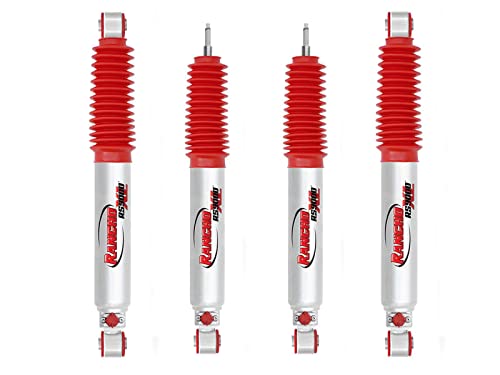
Rancho RS9000XL
Best for: trucks that change jobs: unloaded commuting during the week, trailer or bed load on the weekend.
- • 9-position manual damping adjustment
- • Velocity-sensitive valving
- • Sintered iron construction with protective boot
- • Excellent for mixed towing and commuting
Why it made the list: The Rancho RS9000XL is useful because it is manually adjustable. Rancho says the shock has nine damping positions and is intended for stock or lifted trucks, SUVs, and Jeeps that tow, haul, or go off-road: Rancho RS9000XL features. Rancho’s adjustment guide maps settings 1-3 near OE ride feel, 4-6 firmer, and 7-9 for maximum control, towing, and heavy loads: Rancho RS9000XL adjustment guide.
Road manners: That adjustability is not magic. It is a practical knob. If your truck carries an empty bed most of the time but sometimes pulls a boat, utility trailer, or camper, you can firm the shock for load control and back it down later.
Watch-outs: The tradeoff is maintenance and access. If the knob lives in mud, salt, or road grime, turn it periodically and keep it clean. A shock you never adjust may not need an external knob.
Shopping tip: For Amazon shoppers, match the RS9000XL part number from Rancho’s vehicle lookup before price-comparing. Front, rear, stock-height, and lifted applications are easy to mix up.
Heavy-Duty Control: KYB MonoMax
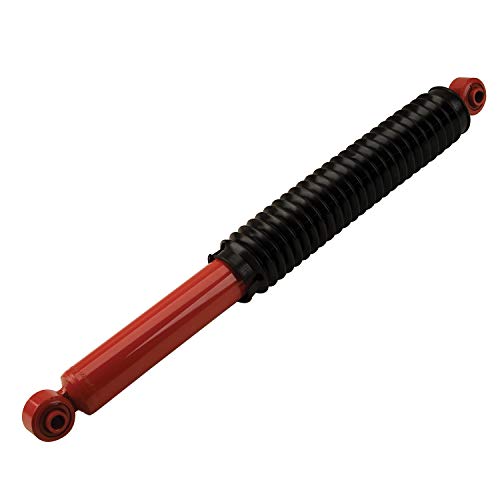
KYB MonoMax
Best for: work trucks, trucks with heavier wheel-and-tire packages, plow trucks, tow rigs, and drivers who prefer firmer control over a soft ride.
- • High-pressure monotube design
- • Firmer control for heavy cargo or towing
- • Separates gas and oil to prevent fade
- • Calibrated to control heavier aftermarket wheel/tire packages
Why it made the list: KYB says MonoMax shocks use a high-pressure monotube design that separates gas and oil to reduce foaming and fade, and KYB describes them as tow-ready for trucks used for towing, heavy loads, or plowing. KYB also notes that larger aftermarket wheels can add weight at each corner and that OE dampers are calibrated around original tires and wheels: KYB MonoMax.
Road manners: This is the kind of shock I would consider when a truck feels like it is carrying more truck than the original dampers were asked to manage. A service body, steel bumper, winch, camper shell, bed drawer system, or heavier tires can all push the setup in that direction.
Watch-outs: The warning is ride firmness. A heavy-duty shock can feel too stiff on an empty half-ton if the rest of the truck is light.
Shopping tip: For Amazon shoppers, start with KYB’s vehicle lookup and use the exact MonoMax part number. A single rear shock, front strut, and four-corner kit can all show up beside each other in search results.
Premium Off-Road: FOX 2.0 Performance Series
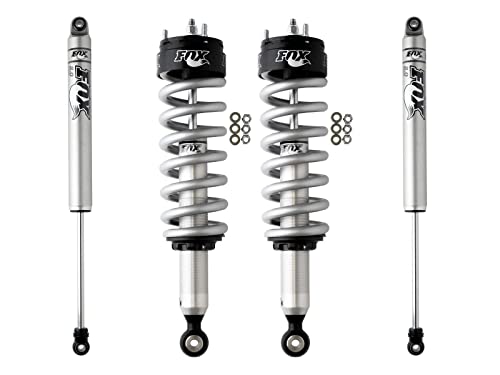
FOX 2.0 Performance Series
Best for: trucks that see rough roads at speed, desert trails, forest roads, and repeated heat cycles where a basic replacement shock feels out of its depth.
- • Internal Floating Piston (IFP) monotube design
- • Premium off-road and rough two-track control
- • 6061-T6 aluminum body dissipates heat
- • Application-specific valving
Why it made the list: FOX’s 2.0 Performance Series truck shocks use an IFP monotube layout, with an internal floating piston separating oil from nitrogen gas, and FOX describes application-specific valving for truck and SUV use. A premium off-road shock like this is not automatically better for a grocery-getter. It is better when you actually use the truck in conditions where shock heat and repeated suspension movement matter: FOX 2.0 Performance Series.
Road manners/Towing: If you mostly tow on pavement, a heavy-duty street/tow shock may be the smarter buy. If you spend hours on washboard or rough two-track, a better off-road damper can make the truck less tiring to drive.
Monotube vs Twin-Tube, in Plain English
The old shorthand says monotube equals control and twin-tube equals comfort. That is too simple, but the idea points in the right direction.
| Design | Practical Feel | Good Fit |
|---|---|---|
| Monotube gas-pressure | Usually firmer, quicker response, better heat control | Towing, heavier trucks, larger tires, off-road |
| Twin-tube hydraulic/gas | Often softer and less expensive | Stock replacements, comfort-first driving |
| Adjustable | Driver can change damping feel within a designed range | Towing sometimes, commuting sometimes |
| Remote reservoir | More fluid capacity and heat management | Faster rough-road use, premium off-road builds |
Valving matters more than the tube label. A well-tuned twin-tube can ride better than a harsh monotube, and a good monotube can be perfectly livable. Match the shock’s intended use to the truck’s real life.
When Shocks Are Not the Real Fix
New shocks will not fix every suspension complaint. They do not raise payload, repair bad alignment, replace sagging springs, or correct unsafe trailer loading.
| Symptom | Check Before Buying Shocks |
|---|---|
| Rear squat under trailer tongue weight | Payload, hitch setup, tongue weight, springs, weight distribution |
| Steering wander | Tires, alignment, ball joints, tie rods, track bar, steering box |
| Harsh ride after lift | Shock length, bump-stop contact, spring rate, tire pressure |
| Tire cupping | Shocks, alignment, balance, worn bushings |
| Driveline vibration after lift | Pinion angle, driveshaft, U-joints |
| Slow acceleration after larger tires | Effective gearing, tire weight, speedometer calibration |
If the truck got larger tires and now feels lazy, read gear ratios and regearing for larger tires before blaming shocks. Shocks control motion. They do not restore mechanical leverage at the axle.
Installation Notes
Many rear shocks are simple bolt-on work if the truck is clean and the hardware cooperates. Front struts, coilovers, rusted mounts, and trucks with electronic suspension are a different conversation.
Before you start:
- Support the truck correctly with jack stands on solid ground.
- Break fasteners loose before removing the old shock completely.
- Replace worn bushings, washers, and hardware if the kit includes them or the old parts are damaged.
- Torque fasteners to the service manual or shock manufacturer’s spec.
- Check brake lines, ABS wires, and suspension travel before driving.
- Get an alignment if the job changes ride height or front suspension geometry.
If the front assembly uses a coil spring, respect it. A compressed spring stores enough energy to hurt you badly. Use the correct tool or let a shop handle that part.
FAQ
How often should pickup truck shocks be replaced?
There is no universal mileage number. Inspect them when the truck bounces after bumps, leaks oil, dives hard under braking, porpoises while towing, cups tires, or feels loose over repeated road joints.
Should I replace all four shocks at once?
Replacing all four gives the most consistent feel. At minimum, replace shocks in axle pairs so left and right behavior matches.
Are stiffer shocks better for towing?
Sometimes. A firmer or adjustable shock can improve control, but it does not increase payload or fix trailer loading. If the rear is squatting hard, check tongue weight, payload, springs, and hitch setup.
Do larger tires require different shocks?
Not always, but larger and heavier tires can make factory shocks feel weak. KYB notes that OE shocks are calibrated around original tire-and-wheel packages, not heavier aftermarket setups.
Are Bilstein 5100 shocks good for stock-height trucks?
Some 5100 applications are intended for lifted or leveling setups, while Bilstein positions the B6 4600 as the stock-height upgrade family. Check the exact application and lift range.
Related Guides
- How to choose pickup truck tires
- Best truck mud tires
- Gear ratios and regearing larger tires
- Best weight distribution hitch with sway control
Sources
- Bilstein B6 4600
- Bilstein B8 5100
- Rancho RS9000XL features
- Rancho RS9000XL adjustment guide
- KYB MonoMax
- FOX 2.0 Performance Series
- 67 Pa. Code Section 175.80
More Featured Guides

Best Weight Distribution Hitches With Sway Control: Sizing and Setup Guide
Choose a weight distribution hitch with sway control by loaded tongue weight, truck payload, trailer frame fit, and real sway-control design.
Read Guide
Best Shocks for Dodge Ram 1500 4x4: Leveling, Towing, and Daily Ride
A practical Dodge Ram 1500 4x4 shock guide covering Bilstein 5100 leveling shocks, Rancho RS9000XL adjustability, stock-height replacements, coil-spring rear suspension, and fitment checks.
Read Guide
Best Lift Kits for Ram 2500: Leveling Spacers, Body Lifts, and Safer Fitment Checks
A practical Ram 2500 lift-kit guide covering steel vs polyurethane spacers, track-bar geometry, alignment checks, tire clearance, and current product examples.
Read GuidePatrick Kinsella
Off-road enthusiast and degreed mechanical engineer for over 15 years. Dedicated to helping you power up your rig for the ultimate adventure.