
Best Snow Chains for 4x4 Trucks: Fitment, 4WD Placement, and Winter Traction
The best snow chains for most 4x4 trucks are Peerless Auto-Trac LT if you want easier installation, SCC Super Z LT if your truck has limited wheel-well clearance, and SCC Quik Grip CAM or Konig XB-16 if you need tougher metal chains for deeper snow and mountain roads. Buy by exact tire size and clearance, not by truck model. Four-wheel drive helps you move, but chain laws, ice, grades, and worn tires can still make chains necessary.
Key Takeaways
- Check the owner's manual before buying chains. Some trucks allow chains only on one axle, require low-clearance chains, or restrict chains with certain tire sizes.
- Match chains to the exact tire size printed on the sidewall, including LT vs P-metric sizing.
- For most part-time 4WD pickups, chains usually go on the rear axle first unless the owner's manual says otherwise.
- Class S or low-clearance chains matter on modern trucks with large tires, tight brake clearance, crash bars, or limited wheel wells.
- Practice installing chains at home before the storm. The shoulder of a mountain road is the wrong classroom.
- We compared current manufacturer specs, chain-law guidance, fitment notes, and practical truck use cases. We did not perform hands-on chain testing.
Quick Picks
Start here if you already know your tire size and chain-clearance limits.
| Chain | Best For | Pattern / Style | Clearance Note | Skip If |
|---|---|---|---|---|
| Peerless Auto-Trac LT | Easiest install for light trucks and SUVs | Diamond chain with self-tightening ratchets | Peerless says it meets Class S clearance in light truck sizes | You need maximum off-road bite |
| SCC Super Z LT ZT751 | Low-clearance 4x4 trucks and SUVs | Z-pattern cable-style traction chain | Designed for restricted-clearance light trucks | Deep off-road snow or frequent chain use |
| SCC Quik Grip QG2228CAM | Traditional heavy-duty pickup use | Ladder twist-link chain with cams | Needs more clearance than cable chains | Your owner manual requires Class S |
| Konig XB-16 | Mountain trips, vans, motorhomes, and pickups | 16 mm manual-tension chain | Konig says it is for pickups, vans, and motorhomes | You want automatic tensioning |
| Glacier 1042 | Occasional highway chain requirement | Ladder cable chain | Low profile, lighter-duty | Heavy truck, plowing, or rough off-road use |
That list is not a fitment guarantee. The same F-150, Ram, Silverado, Tundra, Tacoma, Frontier, or 4Runner can have different tire sizes, wheel offsets, lifts, brake packages, and chain restrictions.
Do 4x4 Trucks Need Snow Chains?
Sometimes. Four-wheel drive helps a truck get moving because more tires can receive engine torque. It does not create extra tire grip, does not make ice disappear, and does not shorten stopping distance by itself.
Chains make sense when:
- A posted chain control requires them.
- You drive mountain passes where laws require carrying chains.
- The truck has all-terrain or mud-terrain tires that are weak on packed snow or ice.
- You tow, carry a load, or drive steep grades in winter.
- You use unplowed forest roads, hunting roads, or remote access roads.
They are usually overkill for normal plowed roads with good winter tires. If your main problem is a light rear end in snow, start with tire condition and moderate bed ballast before assuming chains are the daily answer. Our guide to how much weight to add to a truck bed explains the ballast side of that setup.
Chain Laws Can Still Apply to 4WD
Do not assume “4x4” gets you through every checkpoint. State rules vary.
| State / Agency | Practical Point |
|---|---|
| Colorado CDOT | During a passenger vehicle chain law, every vehicle must have chains or an approved alternative traction device. During traction-law conditions, AWD/4WD vehicles need qualifying tires and 3/16-inch tread depth or chains/ATDs. See CDOT traction and chain laws. |
| California Caltrans | R-2 chain controls generally exempt 4WD/AWD vehicles under the listed gross weight if they have snow-tread tires on all four wheels, but drivers must follow posted chain-control signs and CHP/Caltrans instructions. See Caltrans chain requirements. |
| Washington WSDOT | 4WD/AWD vehicles may be exempt from installing chains under some “chains required” advisories, but they must still carry chains and may need them when conditions worsen. See WSDOT tires and chains. |
| Oregon ODOT | In typical winter conditions, vehicles 10,000 lb GVW or less and not towing may use traction tires in place of chains, but severe conditions can require chains on all vehicles. See Oregon chains and traction tires. |
What to Check Before Buying Chains
Snow-chain shopping starts with the tire sidewall and owner manual.
| Check | Where to Look | Why It Matters |
|---|---|---|
| Tire size | Tire sidewall, driver-door tire label, current tire listing | Chains fit tire dimensions, not just truck model |
| Chain clearance | Owner manual and chain manufacturer fit guide | Prevents chain contact with brake lines, fenders, struts, and suspension |
| Drive axle instructions | Owner manual | Some trucks specify front, rear, or all four wheels |
| Tire type | Sidewall and tire guide | Mud-terrain lugs may need different chain clearance than highway tires |
| GVWR / towing | Door sticker, manual, trip setup | Chain laws and chain strength can change with weight and trailer use |
| Road surface | Highway, mountain pass, unplowed trail, ice | Cable chains, link chains, and V-bar chains solve different problems |
If your truck runs oversized tires, a lift, aftermarket wheels, wheel spacers, mud flaps, or fender liners, do not trust a generic fitment widget by itself. Turn the steering wheel lock-to-lock and look behind the tire. Chain slap can damage brake lines, ABS wiring, fender liners, and bodywork.
The Mechanics of Clearance and Tire Contact Patterns
Understanding the physical limitations of wheel wells and the differences in chain tread patterns prevents vehicle damage and ensures you get the right traction for your driving conditions.
1. Axle Placement for 4x4 Trucks
A common point of confusion is which tires to chain on a four-wheel-drive vehicle.
- Rear Axle Default: For most part-time 4WD pickups, chains should be installed on the rear axle first. The rear of an unloaded pickup is light, so chains provide critical traction and keep the rear end from sliding sideways (fishtailing). Furthermore, steering clearance is rarely an issue on the rear wheels.
- Front Axle Steering: If the owner’s manual permits it and clearance allows, chaining the front wheels can improve steering control on steep downhills. However, front tires sweep through a wide steering angle, bringing chains dangerously close to inner wheel well components.
- All Four Wheels: For severe off-road recovery, plowing, or heavy towing on steep, icy passes, chaining all four wheels offers maximum traction, provided there is adequate clearance on both axles.
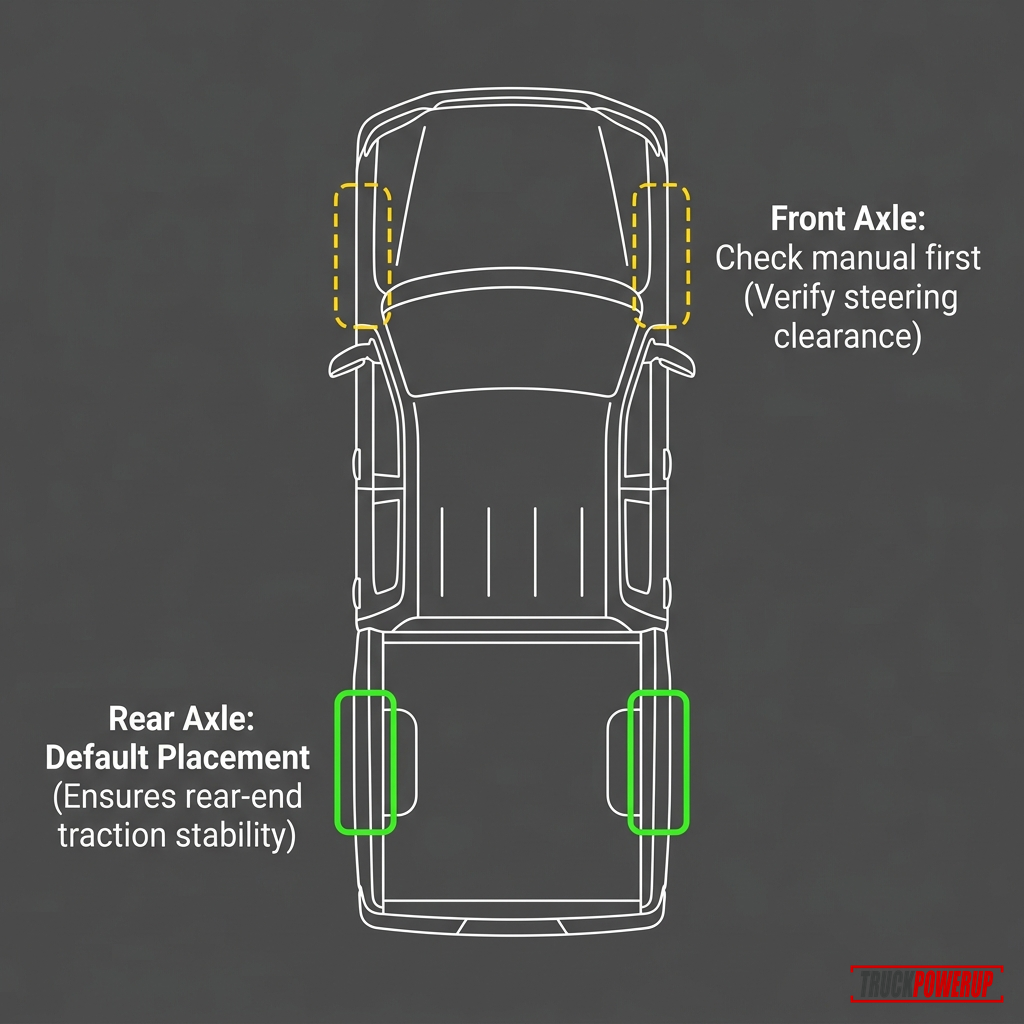
Check your owner’s manual first. If the manual gives a specific chain position, follow it. As a general rule:
| Truck Setup | Common Chain Placement | Why |
|---|---|---|
| Rear-wheel-drive pickup | Rear axle | Rear tires drive the truck |
| Part-time 4WD pickup | Rear axle first, unless manual says front | Rear axle carries load and avoids front steering clearance issues |
| Full-time AWD/4WD SUV | Follow owner manual | Drivetrain and clearance rules vary |
| Steep mountain use with allowed four-chain setup | All four tires | Better balanced steering, braking, and drive traction |
| Towing | Follow manual and chain law | Trailer and tongue weight change the setup |
Four chains can feel more balanced because the front tires steer and the rear tires push, but not every truck allows chains on all four tires. Front chains can contact control arms, brake hoses, fender liners, or sway bar links when steering.
2. Tread Contact and Traction Patterns
Tire chains are not all designed the same way. The shape of the metal or cable pattern on the tread directly impacts how the truck handles:
- Ladder-Pattern Chains: Traditional link chains that run straight across the tire tread like the rungs of a ladder. They provide excellent forward traction to dig through deep snow, but they ride rough on pavement and offer limited lateral (steering) traction.
- Diamond-Pattern Chains: A continuous chain mesh that covers the tire tread in a diamond pattern. Because the chain is always in contact with the ground through rotation, diamond chains ride much smoother on pavement and provide superior lateral traction to prevent sideways slides during cornering.
- Cable Traction Devices: Thin steel cables wrapped with alloy rollers. These have a very low profile, making them ideal for highway passenger cars and tight wheel wells, but they lack the heavy-duty durability needed for serious off-road use or plowing.
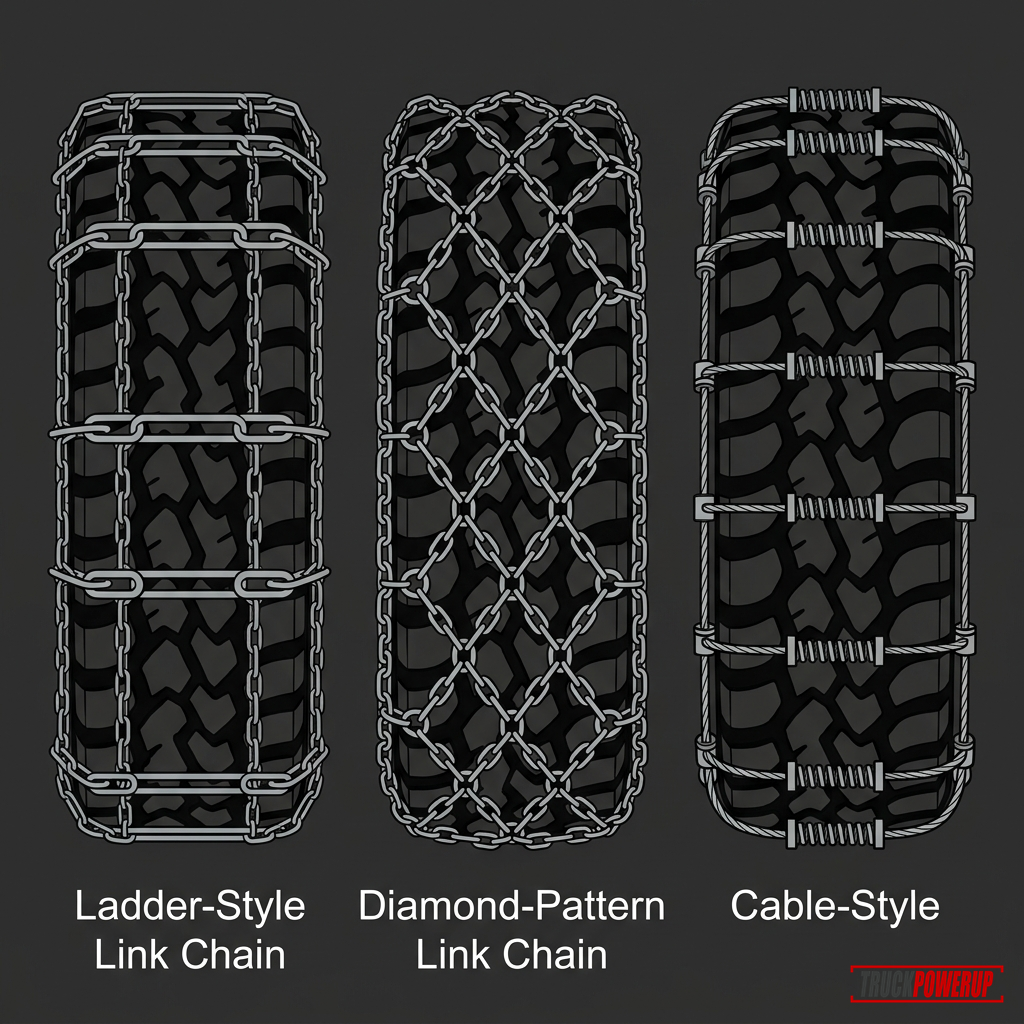
Cable Chains vs. Link Chains vs. Socks Comparison
| Type | Best For | Pros | Tradeoffs |
|---|---|---|---|
| Cable chains | Low-clearance trucks, occasional use | Lighter, usually smoother, easier to store | Less bite and durability than link chains |
| Diamond chains | Road use and smoother traction | Better steering/braking feel than basic ladder chains | Can cost more and still needs exact fit |
| Ladder link chains | Heavy snow, rural roads, work trucks | Strong bite, simple design | Rougher ride, more clearance needed |
| V-bar chains | Ice, plow work, severe traction | Very aggressive | Can damage pavement and may be illegal or unsuitable in some areas |
| Tire socks | Clearance-limited vehicles and legal alternatives where approved | Light, easy to pack, lower vehicle-contact risk | Less durable on pavement, check local approval |
If the truck has tight clearance, start with the owner’s manual and Class S options. If the truck has plenty of clearance and works in deep snow, heavier link chains make more sense.
3. Class S Clearance Checkpoints
On modern pickup trucks and SUVs, manufacturers often fit larger tires while shrinking the space inside the wheel well. This leaves very tight clearance between the tire sidewall and critical mechanical components.
- Strut / Shock Body: The distance between the inner tire sidewall and the strut or shock absorber can be less than an inch.
- Brake Lines and ABS Sensors: A loose chain or a chain that is too thick can snag and sever flexible rubber brake hoses or ABS wire harnesses.
- Fender Liners & Crash Bars: When front wheels turn lock-to-lock, the tire moves close to inner plastic liners and steel crash bars.
- The Class S Standard: Meeting Class S clearance means the traction device requires no more than 15 mm (0.59 inches) of clearance on the inner side of the tire tread and sidewall.
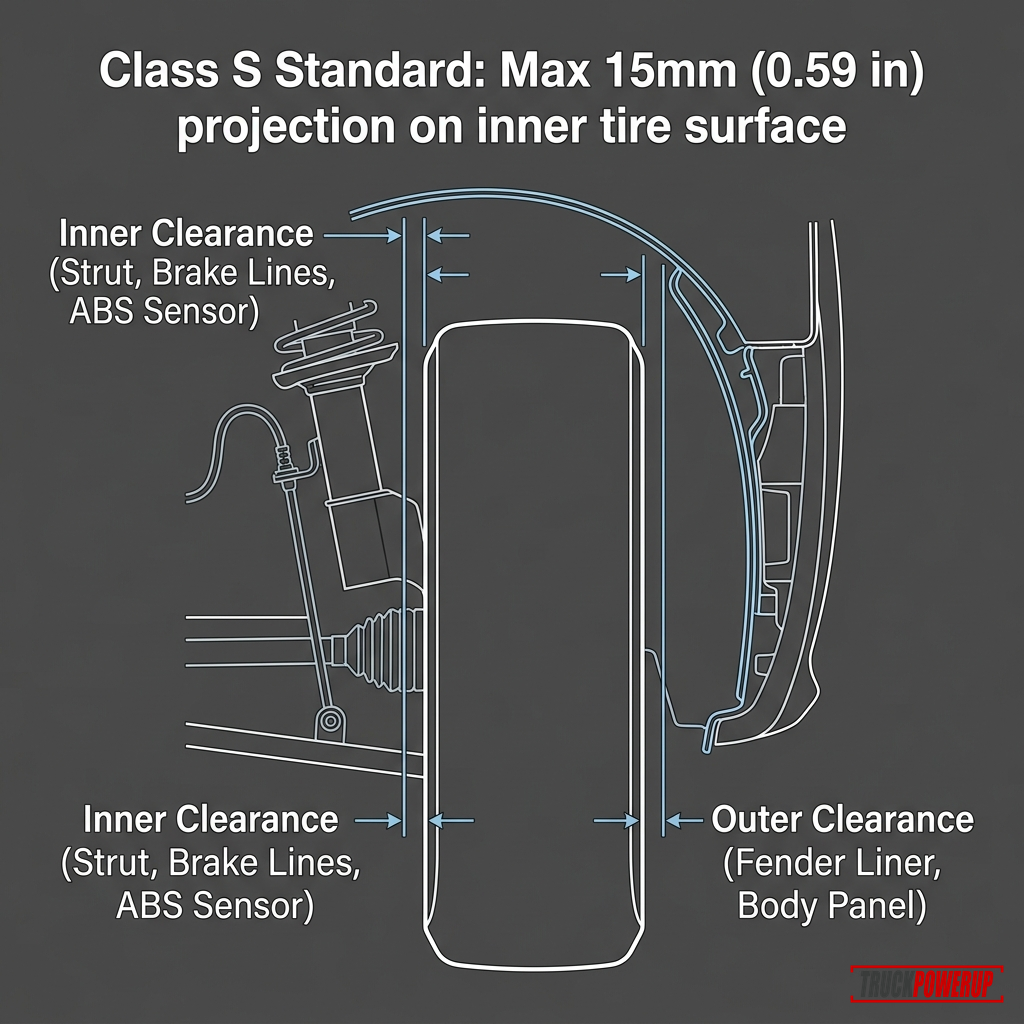
Best Snow Chains by Use Case
Best Overall for Easy Installation: Peerless Auto-Trac LT

Peerless Auto-Trac Light Truck/SUV Tire Chain
Best for: Pickup owners who want a chain that is easier to install correctly in ugly weather.
- • Peerless 0232805 Auto-Trac Light Truck/SUV chain
- • Automatic tightening and centering style
- • Peerless says Auto-Trac LT meets Class S clearance in light-truck sizes
- • Verify exact tire-size fit before ordering
Why it made the list: Peerless describes Auto-Trac LT as a light-truck chain with automatic tightening and centering ratchets. Peerless also says it meets Class S clearance requirements in light-truck sizes.
Road manners: The diamond-style pattern is usually smoother than basic ladder chains because more chain is in contact through the rotation. That matters on paved mountain roads where you may be crawling through chain-control zones.
Traction strength: Better for snow-packed roads, mountain passes, and occasional chain use than for buried farm roads or serious off-road recovery.
Watch-outs: Self-tightening does not mean no checking. Stop after a short distance, inspect the fit, and listen for contact. If the chain is hitting suspension or bodywork, remove it before it damages the truck.
Fitment note: Buy the exact Auto-Trac LT size for your tire. The Amazon product below is a specific product link, not a universal fit.
Best Low-Clearance Chain: SCC Super Z LT ZT751
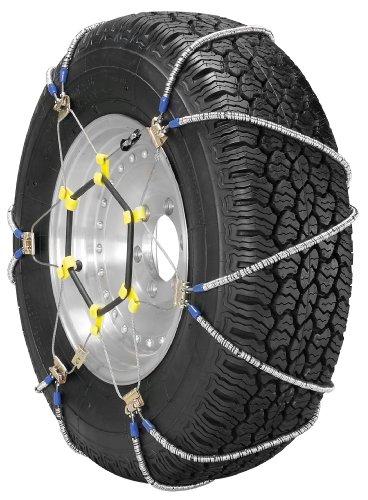
SCC Super Z LT ZT751
Best for: 4x4 trucks, SUVs, and crossovers with tighter wheel wells or owner-manual clearance warnings.
- • SCC ZT751 Super Z LT
- • Low-clearance light-truck/SUV chain style
- • Useful for ABS and traction-control-equipped vehicles
- • Confirm tire-size fit and owner-manual clearance
Why it made the list: Peerless lists the Z SUV/LT cable chain as a light truck and SUV option. Z-pattern cable chains are often easier to fit on restricted-clearance vehicles than traditional link chains.
Road manners: Better than heavy ladder chains for ABS/traction-control friendliness and lower-clearance vehicles, but still louder and slower than normal tires.
Traction strength: Good for chain-control compliance, snow-packed roads, and moderate winter traction. Not the top pick for deep off-road snow, mud, or plow work.
Watch-outs: Cable-style chains are not magic. If your truck is heavy, loaded, towing, or driven often in chains, a more substantial link chain may be better if clearance allows.
Fitment note: This is a specific ZT751 product link. Confirm your exact tire size in the current fit guide.
Best Heavy-Duty Traditional Chain: SCC Quik Grip QG2228CAM

SCC Quik Grip QG2228CAM
Best for: Trucks that need stronger metal chains and have enough clearance for a traditional ladder chain.
- • SCC QG2228CAM Quik Grip light-truck chain
- • Traditional ladder chain with cam tightening
- • Better bite than light cable chains when clearance allows
- • Verify tire-size fit and tensioner requirements
Why it made the list: Quality Chain’s current traction catalog lists regular cam-style light-truck chain families and shows the 2228QC/related sizes in its light-truck highway chain section: Quality Chain 2026-27 catalog.
Road manners: Ladder chains ride rougher than diamond or cable chains. They are noisy, slower, and more physical to handle, but the bite can be stronger when the truck is working in snow.
Traction strength: Better for deep snow, heavier pickups, job sites, rural driveways, and occasional off-pavement use when clearance allows.
Watch-outs: These need enough sidewall and suspension clearance. They may require separate tensioners and a cam tool. Practice at home before relying on them.
Fitment note: The linked QG2228CAM product is one specific size. Do not buy it unless your tire size appears in the manufacturer’s fitment list.
Best Manual Chain for Mountain Trips: Konig XB-16
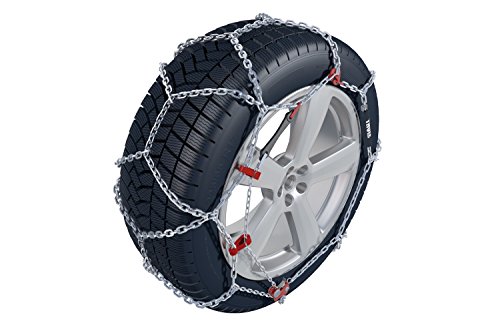
Konig XB-16 Snow Chains
Best for: Pickups, vans, and motorhomes where a sturdy 16 mm chain is allowed by the vehicle manual.
- • Konig XB-16 chain
- • Konig describes XB-16 as a pickup, van, and motorhome chain
- • 16 mm link family
- • Verify the correct XB-16 size for your tire before ordering
Why it made the list: Konig says the XB-16 is for pickups, vans, and motorhomes and uses 16 mm links. The product is simple, sturdy, and more old-school than automatic-tension designs.
Road manners: Expect chain noise and a slower drive. This is a pragmatic winter-driving chain, not the smoothest commuter option.
Traction strength: A good match for mountain trips and tougher snow conditions when you have enough clearance and are comfortable with manual tensioning.
Watch-outs: Manual tensioning means you may need to stop, check, and retighten. That is not a defect; it is part of using this style safely.
Fitment note: Konig XB-16 comes in different sizes. The Amazon link below is a specific XB-16 product, but your tire may require a different XB-16 size.
Best Occasional Highway Cable Chain: Glacier 1042

Glacier 1042 Cable Tire Chains
Best for: Drivers who need a lighter chain option for occasional highway chain controls, not hard truck work.
- • Glacier 1042 cable chain
- • Lighter-duty highway chain option
- • Lower-profile than many link chains
- • Confirm tire fit and avoid heavy-duty use
Why it made the list: Glacier 1042 belongs here as a lighter-duty cable-style choice, not as the main recommendation for heavy 4x4 trucks.
Road manners: Smoother and lighter than traditional link chains, but less aggressive.
Traction strength: Enough for occasional packed snow and chain-control compliance if it fits your tire and vehicle. Not the first choice for plowing, towing, mud, or deep snow.
Watch-outs: Cable chains wear faster when driven on bare pavement. Remove them when the road clears.
Fitment note: This direct Amazon product link is one specific Glacier size. Confirm fit before ordering.
How Fast Can You Drive With Chains?
Most chain manufacturers and road agencies expect slow speeds with chains. A 30 mph ceiling is a practical upper limit for many chain setups, and many drivers should go slower.
Use chains like emergency traction, not winter tires:
- Keep speed low.
- Avoid sudden throttle, braking, and steering.
- Stop if you hear slapping or metal contact.
- Remove chains when pavement clears.
- Do not drive on broken chains.
Chains are for traction at low speed. They are not a license to drive normal highway speeds in a storm.
How to Install Chains Without Hating Your Life
Practice once on dry pavement before winter. Then pack the kit where you can reach it without unloading the whole bed.
Bring:
- Chains in a case or heavy bag.
- Waterproof gloves plus warm gloves.
- Headlamp.
- Kneeling pad or old floor mat.
- Small shovel.
- Tensioners if the chain requires them.
- Owner manual or printed fitment notes.
Basic install flow (Choose the method matching your chain type):
Method A: The Roll-On Method (For traditional ladder and heavy-duty link chains)
- Park safely: Find a level, safe spot off the road. Set the parking brake and turn on hazard lights.
- Lay flat and untwist: Lay the chains flat on the ground directly in line with the tires (either in front or behind), making sure the cross-chain hook points are facing up (away from the tire rubber) to prevent puncture.
- Position the truck: Drive the truck forward (or backward) about 1 to 2 feet so the tires roll directly onto the middle of the laid-out chains, leaving enough loose chain on both sides to wrap up.
- Drape and secure: Pull the ends of the chain up over the top of the tire. Connect the inner (backside) hook/fastener first, then connect the outer (frontside) connector. Ensure the chain is centered on the tread.
- Lock cams and tensioners: If your chains have built-in cams, use the cam tool to turn and lock them. Otherwise, stretch rubber tensioners across the outer face of the wheel.
- Drive and recheck: Drive forward 15 to 30 feet, stop, and inspect the fit. As the chain settles, it will loosen, requiring you to adjust the slack by a link or two.
Method B: The Feed-Through Method (For modern cable and diamond-mesh chains)
- Park safely: Find a level, safe spot, engage the parking brake, and turn on hazards.
- Lay flat and slide behind: Lay the chain flat to untangle. Slide the main support cable behind the tire from the front to the back of the wheel.
- Connect the inner cable: Pull both ends of the inner cable up over the top of the tire and link them together behind the tread.
- Latch the front connectors: Let the chain mesh drape forward over the tire face, then latch the front/outer connectors securely.
- Engage tensioners: Pull the tightening chain through the lock ratchet and secure the tensioning hooks (or let the automatic ratchets engage).
- Drive and recheck: Drive forward 15 to 30 feet, stop, and verify the chain has centered itself and remains snug.
If the chain is too loose or slaps against the wheel well, pull over immediately to tighten it. A loose chain can sever brake lines and ABS sensors.
Common Mistakes
Buying by Truck Model
“Fits Silverado” or “fits Tacoma” is not enough. Tire size, wheel offset, trim, lift, and tire brand can change fit.
Ignoring Class S Clearance
Modern trucks can have less chain clearance than they look like they should. If the manual says Class S, buy Class S or a manufacturer-approved alternative.
Carrying Chains You Have Never Installed
Unopened chains in the rear seat are not much help if you cannot get them on in freezing wind. Practice at home.
Using Chains as a Substitute for Tires
Chains help in specific conditions, but worn tires are still worn tires. If you are choosing tires for winter, start with pickup truck tire basics.
Leaving Chains on Bare Pavement
Bare pavement wears chains quickly and can damage tires. Remove them when chain controls end or the road clears.
Forgetting Bed Weight and Load
A loaded truck, empty truck, and truck towing a trailer can all behave differently in snow. If the rear end feels light, read the truck bed winter ballast guide before piling random weight in the bed.
FAQ
What are the best snow chains for a 4x4 truck?
Peerless Auto-Trac LT is a good easy-install starting point, SCC Super Z LT is useful for low-clearance trucks, and traditional cam ladder chains like SCC Quik Grip make sense when you need stronger bite and have enough clearance.
Do chains go on the front or rear of a 4x4 truck?
Follow the owner’s manual. If the manual does not specify, many part-time 4WD pickups start with chains on the rear axle because the rear axle carries load and front steering clearance is tighter.
Should I put chains on all four tires?
Only if the vehicle manual allows it and you have four matching chains. Four chains can give more balanced control, but front chains can hit suspension or body parts on some trucks.
Are cables better than chains for trucks?
Cables are better for low-clearance and occasional road use. Link chains are usually better for deeper snow, heavier trucks, and harder use if the truck has enough clearance.
Can I use snow chains with mud tires?
Sometimes, but mud-terrain tires have large lugs and can change chain fit. Check the chain manufacturer’s fit guide for your exact tire size and inspect clearance carefully.
How fast can you drive with snow chains?
Keep it slow. Many chain products and road conditions call for speeds around 30 mph or less, and rough conditions may require much slower driving.
Do 4WD trucks have to carry chains?
Sometimes. Washington, Colorado, California, Oregon, and other winter states can require carrying or installing chains depending on road signs, chain-control level, vehicle weight, tires, and weather.
Related Winter Truck Guides
Chains are only one option. Compare them with dedicated winter tires and bed ballast in winter tires vs snow chains vs bed weight.
- How much weight to add to a truck bed for winter traction
- How to choose pickup truck tires
- Best mud tires for daily-driven trucks
Sources Checked
- Peerless Auto-Trac LT
- Peerless light truck tire chains
- Konig XB-16
- Quality Chain 2026-27 traction catalog
- Colorado traction and chain laws
- Colorado State Patrol chain-law information
- Caltrans chain requirements
- WSDOT tires and chains
- Oregon chains and traction tires
More Featured Guides

How Much Weight Should You Add to a Truck Bed for Winter Traction?
Most pickups need only modest winter ballast. Here is how much weight to add, where to place it, what to use, and what to avoid.
Read Guide
Winter Tires vs Snow Chains vs Bed Weight: Which Pickup Traction Fix Should You Actually Use?
Compare dedicated winter tires, snow chains, and truck bed ballast. Learn the right traction fix for your pickup based on drivetrain, payload, and chain laws.
Read Guide
Best Shocks for Pickup Trucks: Stock, Towing, Off-Road, and Lifted Setups
Choose pickup truck shocks by ride height, towing load, tire weight, road use, and exact fitment. Compare Bilstein, Rancho, KYB, and premium off-road options.
Read GuideKelley Crush
Kelley is a mechanical engineer and a truck enthusiast. He's currently an F-250 guy, but he promises to respect any well-equipped and properly utilized truck.