
Winter Tires vs Snow Chains vs Bed Weight: Which Pickup Traction Fix Should You Actually Use?
Key Takeaways
- Tires solve braking; ballast solves axle spin; chains get you through checkpoints: Dedicated 3PMSF winter tires improve turning and stopping on cold pavement, bed weight helps an unloaded rear axle bite when pulling away, and chains are a low-speed mechanical emergency tool for severe passes or statutory chain controls.
- 4WD helps you accelerate, not stop: Four-wheel drive does not add grip when you step on the middle pedal because every modern pickup already has four-wheel brakes.
- Bed ballast eats directly into your payload: Every pound of sand you slide over the axle takes away from your door-jamb payload capacity, so do not toss 400 pounds into a truck that is already hauling passengers, gear, or tongue weight.
- Your owner's manual overrides aftermarket fitment widgets: Many modern half-ton and heavy-duty trucks strictly prohibit standard ladder chains on factory tire sizes due to tight clearance near brake lines, struts, and ABS wheel-speed sensors.
Every November, pickup truck forums turn into an argument about winter traction. One camp insists that throwing six bags of tube sand against the tailgate solves everything, another guy claims his part-time four-wheel-drive system makes him invincible on factory all-season rubber, and someone else argues you should never leave the driveway without heavy ladder chains under the back seat.
The trouble is that these three fixes do completely different jobs on a pickup chassis. An empty truck has a severe front-to-rear weight imbalance, which makes the unloaded rear tires break loose easily on a snowy incline. But fixing that unloaded launch spin does nothing to help you stop three tons of steel once you are rolling at highway speeds. If you pick the wrong fix for the road conditions in front of you, you end up with damaged suspension hardware, an overloaded rear axle, or an expensive ride into a ditch.
Here is how to look at dedicated winter tires, tire chains, and bed ballast through an engineering lens, so you spend your money and your garage time on the fix that actually matches your driving route.
The Winter Decision Ladder: Tires Stop the Truck, Weight Settles the Axle, Chains Pass the Checkpoint
Before you spend a dime, you need to know which mechanical failure mode you are actually trying to solve. A pickup truck handles winter weather differently than an SUV or a sedan because roughly sixty percent of the curb weight sits over the front suspension when the bed is empty. That leaves the rear drive axle starved for downward vertical load, which causes the rear tires to spin freely on slick pavement.
| Order | Path | Solves | Limitation |
|---|---|---|---|
| 1 | Baseline: dedicated 3PMSF winter tires on all four corners | Braking distance, lateral grip, cold pavement below ~45°F | Up-front cost; off-season storage |
| 2 | Rear-axle helper: secured bed ballast (100–300 lb over the axle) | Unloaded 2WD/4WD rear wheelspin from a stop | Adds mass you still have to stop; eats door-sticker payload |
| 3 | Severe pass / legal checkpoint: snow chains or cables | Deep snow, steep unplowed grades, statutory chain controls | 25–30 mph ceiling; harsh on dry pavement and tight wells |
When you look at this hierarchy, the default path becomes obvious. If your truck struggles to stop or slide sideways on cold, plowed streets, ballast and 4WD will not save you; dedicated winter rubber is the only real fix. If your truck has healthy winter tread but you cannot leave a stop sign in an empty two-wheel-drive truck without the traction control light flashing furiously, strapping modest weight over the rear axle settles the differential. If you run into severe mountain passes, unplowed rural access roads, or a state trooper standing beside a chain-control checkpoint, chains are the mechanical hammer you pull out to claw through packed ice at twenty-five miles per hour.
Before you load the bed or order hardware, match your situation to the path that actually fits.
| If this is your situation | Then do this |
|---|---|
| Remaining payload is already eaten by a topper, toolbox, heavy passengers, or tongue weight | Run dedicated 3PMSF winter tires on all four. Do not add dead weight to an axle that is already loaded. |
| You drive a 4x4 already on dedicated winters, and the problem is braking rather than pulling away | Keep the bed empty and leave more following distance. Extra mass only lengthens stops on ice. |
| You were about to use loose cinder blocks, scrap steel, uncovered gravel, or frozen snow piles | Use purpose-built tube sand strapped over the axle, or read how to properly add weight to a truck bed. Loose hard mass becomes a cab projectile in a crash. |
| The owner’s manual bans chains for your factory wheel and tire size | Stick with dedicated winters, or confirm an approved alternative traction device (for example a textile tire sock) that your state and manual both allow. |
| Wider aftermarket tires, negative-offset wheels, or a level kit without verified inner clearance | Measure clearance at full lock, or use SAE Class S low-profile cables only if the manual clears them. |
| Everyday commute on plowed, salted city highways | Mount 3PMSF winters. Chains on bare or patchy asphalt chew tread, pavement, and cross-links. |
| Winters stay above ~45°F and you only cross one snowy pass a year | Keep 3PMSF-rated all-terrains and carry a manual-compliant chain pair in the cab for that pass. |
Pre-Flight Fitment Checks Before You Buy Rubber, Metal, or Sand
Before you buy a set of winter tires, pick up a pair of traction chains, or stack sandbags at the home improvement store, you need to read the physical data plates on your truck. Every pickup has strict engineering limits stamped right into the driver-side B-pillar and molded into the tire sidewalls. Guessing at these numbers is how truck owners end up stripping wheel-speed sensor wiring or bending suspension bump stops.
Example B-pillar tire and loading label fields to read before you shop:
| Label field | Example | What it decides |
|---|---|---|
| Combined weight of occupants and cargo (payload cap) | 680 kg / 1,500 lb | How much ballast and people you can still add |
| Original front tire size | 275/65R18 | Size and load index you must match or exceed |
| Original rear tire size | 275/65R18 | Same — winter sizes that drop load index are a fail |
| Cold tire inflation pressure | 240 kPa / 35 PSI | Starting cold-pressure baseline from the placard |
First, check the yellow-and-white Tire and Loading Information placard on your driver-side door jamb. That sticker lists your maximum allowable payload capacity. Remember that every single accessory you bolt on, every passenger you carry, your bed liner, your heavy-duty hitch receiver, and any winter ballast you slide in counts directly against this number. If your truck has a 1,400-pound payload rating and you already have a 200-pound topper, a 150-pound drawer system, and 400 pounds of people inside, adding 400 pounds of wet sandbags leaves you virtually no margin for dynamic suspension travel or cargo.
Second, check your tire sidewalls for the actual markings rather than assuming what you have. A standard M+S (Mud and Snow) stamp is simply an industry geometric declaration meaning the tread pattern has at least twenty-five percent open void space; it does not require any standardized cold-weather traction testing.
In contrast, the Three-Peak Mountain Snowflake (3PMSF) symbol signifies that the tire passed ASTM F1805 testing on medium-packed snow, achieving a standardized traction index at or above 110 (or 112 with SRTT16 test standards) as outlined by the U.S. Tire Manufacturers Association (USTMA) Bulletin 37. That severe-snow rating accounts for rubber compounding that remains pliable below 45 degrees Fahrenheit, whereas basic all-season rubber hardens into a hockey puck in sub-freezing weather.
| Parameter | Where | What to look for | What it decides |
|---|---|---|---|
| Available Payload | Driver B-pillar yellow-and-white sticker | ”The combined weight of occupants and cargo should never exceed…” | Dictates whether you have the margin to carry bed ballast without overloading the truck once passengers and gear are loaded. |
| Rear Gross Axle Weight (RGAWR) | Driver B-pillar safety certification label | Specific gross axle rating for the rear axle assembly (RGAWR). | Prevents rear spring sagging and bearing overload. Placing heavy weight too far behind the axle levers weight off the front and overloads the rear. |
| Drivetrain Configuration | Dash selector / transfer case badge | Part-time 4WD, full-time auto 4WD/AWD, or open-differential 2WD. | 2WD trucks benefit heavily from 100–300 lb of ballast over the axle; 4WD trucks generally only need weight if the tail steps out under light throttle. |
| Tire Size & Load Index | Tire sidewall & door jamb placard | Exact metric string (e.g., LT275/65R18 123/120R or P265/70R17 113T). | Chains fit the exact tire dimensions, not the truck model. Replacement winter tires must meet or exceed OEM load index ratings. |
| Winter Certification Stamp | Tire sidewall | Mountain outline with a snowflake inside (3PMSF) vs bare M+S stamp. | Determines whether you have true cold-weather chemical compounding or just an open tread pattern, and satisfies state passenger traction laws. |
| Usable Tread Depth | Tire tread grooves across the face | Tread depth gauge reading in 32nds of an inch (never rely on a coin test). | Colorado traction law requires at least 3/16 inch (6/32”); Washington requires 1/8 inch (4/32”). Our house rule is 6/32” minimum for reliable winter bite. |
| Owner Manual Chain Rules | Truck glovebox manual under “Tire Chains” | Explicit tire size bans, axle restrictions (rear only), and SAE Class limits. | Tells you if full-size chains will tear out your front brake lines or strut towers. Many modern half-tons require SAE Class S cables only. |
| Inner Fender Clearance | Wheel wells at full lock (left and right) | Distance between tire sidewall and upper ball joint, sway bar, or brake lines. | Verifies whether you can physically run a traditional ladder chain or if you are strictly limited to low-profile cables or wheel-face traction wraps. |
If you are changing tire sizes or moving from a P-metric passenger tire to a heavier LT-rated tire for winter, run your dimensions through our tire size and speedometer calculator to check speedometer error and ensure your replacement rubber maintains the correct load-carrying capacity at proper inflation pressures.
How the Three Fixes Behave Under Real Driveway and Road Constraints
Now that you have your truck’s baseline numbers, let us compare how these three options perform across the operating conditions you will actually face on the road. Do not think of this as a competition where one product wins an arbitrary trophy. Every choice trades off purchase cost, installation misery, mechanical clearance, and maximum safe driving speed.
| Fix | How it grabs the road | What you notice |
|---|---|---|
| Winter tires | High-silica compound stays soft below ~45°F; sipes trap snow for snow-on-snow shear | Normal road speeds, quieter than chains, full steering and braking control |
| Bed ballast | Extra vertical load (normal force) over the rear drive tires | Better launch bite on empty 2WD/4WD; more mass the brakes still have to stop |
| Snow chains | Steel cross-links or hardened rollers mechanically interlock with ice and pack | Harsh vibration; 25–30 mph ceiling; needs clearance or they chew wells and lines |
Winter tires rely on specialized chemistry and micro-mechanical grip. Standard all-season and highway-terrain compounds use rubber blends that begin hardening as ambient temperatures drop below 45 degrees Fahrenheit, causing the tread blocks to slide across cold asphalt like hard plastic. Dedicated winter tires incorporate high-silica rubber compounds that remain flexible well below freezing, alongside dense networks of zigzag siping. These sipes open up as the tire rolls, packing snow into the grooves to create snow-on-snow shear friction, which offers vastly superior traction compared to cold rubber sliding over smooth ice.
Bed ballast works purely through gravitational physics by increasing the vertical normal force applied to the rear contact patches. Because an unloaded truck bed places so little mass over the drive axle, an open differential will easily spin one wheel on an icy driveway. Adding weight over the axle increases traction for starting off from a dead stop. However, adding mass is a double-edged sword. While it aids acceleration, that added weight increases the linear momentum of the vehicle, which means your front brakes have to dissipate significantly more kinetic energy when trying to bring the truck to a complete stop on slick downhills.
Snow chains bypass rubber friction entirely by establishing a positive mechanical interlock between the road surface and the tire. Hardened steel cross links or manganese alloy rollers crush down into hard-packed snow and bite into sheet ice. This provides unmatched climbing and downhill holding power, which is why commercial mountain passes mandate them during severe storms.
The downside is mechanical violence. Chains rattle your drivetrain, restrict your vehicle speed to a strict 25 to 30 mph ceiling, and will shred your inner fender liners, ABS harnesses, and brake lines in seconds if a tensioner snaps or if your truck lacks sufficient clearance.
| Driving Job / Road Constraint | Dedicated 3PMSF Winter Tires (All 4) | Snow Chains or Traction Cables | Bed Ballast (100–300 lb Over Axle) |
|---|---|---|---|
| Everyday Snowbelt Commuting (Plowed roads, cold rain, packed patches) | Best Choice. Rubber remains compliant below 45°F; handles, steers, and stops at normal traffic speeds. | Terrible. Rough ride, 30 mph speed ceiling, and bare asphalt rapidly grinds down the cross links. | Minor helper for empty 2WD trucks; generally unnecessary for 4x4 trucks on good winter rubber. |
| Unloaded 2WD Take-Off From A Stop | Improves drive grip noticeably, but a completely empty tail may still break loose on steep ice. | Overkill for basic neighborhood driving; impractical to mount and dismount for short daily commutes. | Best Value Helper. 200–300 lb centered directly over the axle stops the rear tires from spinning on take-off. |
| Hard Braking On Packed Snow or Ice | Best Choice. All four contact patches work together to stop the truck without early ABS lockup. | Strong bite at low speeds, but chains are not engineered for panic stopping from highway speeds. | Negative Trade-Off. Extra weight increases total momentum and can actually increase stopping distances. |
| Statutory Mountain Pass Checkpoints (e.g., CA R-2/R-3, CO Chain Law, WA I-90) | Satisfies passenger traction rules in many states, but does not fulfill mandatory chain orders. | Legally Mandatory. Required for commercial rigs and all passenger vehicles during severe emergency closures. | Completely irrelevant to state troopers and highway checkpoint inspectors. |
| Owner Manual Clearance Limitations (Factory 20-inch wheels, tight ball joints) | Zero fitment conflict as long as you match factory tire dimensions and load ratings. | High risk. Traditional ladder chains often hit suspension arms. Class S cables or textile socks required. | Zero clearance conflict with suspension or wheel wells. |
| Towing Heavy Loads / Fifth-Wheel | Essential. Ensure the winter tire’s load index and load range (e.g., Load Range E) matches or exceeds OEM. | Allowed if manual permits, but trailer axles often require their own dedicated braking chains by law. | Skip Entirely. Trailer tongue weight or pin weight acts as your rear axle ballast; adding bags overloads the truck. |
| Driving Job / Road Constraint | Practical Combined Strategy |
|---|---|
| Everyday Snowbelt Commuting | Mount 3PMSF tires on all four wheels. Leave the bed empty unless an unloaded 2WD tail spins on slight grades. |
| Unloaded 2WD Take-Off From A Stop | Combine good all-weather or winter tires with 200 lb of secured tube sand over the axle. |
| Hard Braking On Packed Snow or Ice | Run winter tires on all four wheels; rely on conservative following distances rather than adding bed weight. |
| Statutory Mountain Pass Checkpoints | Carry an approved, pre-fitted set of chains or Class S cables in the cab while running 3PMSF tires on the truck. |
| Owner Manual Clearance Limitations | Check your manual’s tire chain section; use Class S cables or approved textile devices if chains are restricted. |
| Towing Heavy Loads / Fifth-Wheel | Use our hitch setup calculator to verify tongue weight, and omit supplemental bed sandbags completely. |
Four Pickup Scenarios Where One Setup Clearly Beats the Others
Because pickup trucks vary widely in suspension layout, weight distribution, and usage, a single winter traction recipe does not work for everyone. Here are four common real-world driving environments and the exact mechanical setup that works best for each.
| Scenario | Setup | Why |
|---|---|---|
| Empty 2WD commuter | 200–300 lb tube sand strapped over the axle + 3PMSF tires | Offsets the light rear so the drive tires can bite from a stop |
| Snowbelt 4x4 highway driver | Dedicated 3PMSF winters on all four; no bed weight | Maximizes steering and four-wheel braking at normal speeds |
| Mountain pass checkpoint traveler | Quality A/T or winters + matched chains in the cab | Clears legal chain controls and keeps deep-ice bite available |
| Modern half-ton with tight clearance | 3PMSF tires + SAE Class S low-profile cables | Protects ABS brackets and inner fender liners from ladder chains |
Scenario 1: The Empty 2WD Half-Ton Running Daily Winter Chores
If you daily drive an unloaded two-wheel-drive pickup in regions that see recurring winter freezes, your main mechanical problem is low vertical force on the drive tires. With an empty steel or aluminum bed, a standard open rear differential will send power straight to whichever rear wheel has the least resistance, leaving you stranded at flat intersections on packed snow.
- The Right Setup: Place 200 to 300 pounds of bagged tube sand directly over or slightly ahead of the rear axle centerline, tightly secured with 2-inch ratchet straps or a wooden divider board. Match this ballast with tires carrying the 3PMSF severe-snow emblem.
- Why It Works: Adding 250 pounds directly over the axle increases normal force significantly without overloading the rear leaf springs. This helps the sipes on your drive tires bite into the snow pack without causing your rear end to constantly fish-tail under light acceleration.
- What to Avoid: Do not throw the sandbags all the way back against the tailgate. Placing weight behind the rear axle creates a lever effect across your rear suspension, which unloads weight from the front steering tires and makes your truck understeer dangerously when turning into icy corners.
Scenario 2: The Snowbelt 4x4 Highway Commuter
If you drive a four-wheel-drive half-ton or three-quarter-ton truck on plowed highways, country two-lanes, and slushy interstate corridors, your primary safety risk is not getting moving from a stop. Your transfer case already splits torque across both axles to pull you away cleanly. Your real threat is stopping and cornering at 45 to 60 mph on cold, black ice.
- The Right Setup: Mount four dedicated 3PMSF winter tires matching the load index and sizing on your B-pillar placard, and leave the truck bed empty.
- Why It Works: Modern four-wheel-drive systems give drivers false confidence because the truck accelerates easily on slick roads. However, when you step on the brake pedal, 4WD provides zero additional stopping power because every vehicle on the road already has four-wheel brakes. Dedicated winter tires shorten braking distances dramatically on cold, frozen asphalt compared to standard all-season rubber.
- What to Avoid: Skip the extra bed ballast. A 4x4 pickup already carries extra drivetrain mass up front via the front differential, half-shafts, and transfer case. Adding dead weight in the bed simply increases the total kinetic energy that your four tires have to stop during an emergency braking maneuver.
Scenario 3: The Mountain Pass Traveler Facing DOT Chain Controls
If you regularly drive through high-elevation mountain corridors—such as Interstate 80 over Donner Summit in California, Interstate 70 through the Eisenhower Tunnel in Colorado, or Interstate 90 over Snoqualmie Pass in Washington—you are subject to strict statutory chain controls enforced by state highway patrols.
- The Right Setup: Run 3PMSF-rated all-weather, all-terrain, or winter tires with healthy tread depth (at least 6/32 of an inch), and carry a properly fitted, pre-tested set of tire chains or cables in your cab or dry toolbox.
- Why It Works: State chain-control laws use multi-tiered restriction levels. For example, under California’s Caltrans R-2 restrictions or Washington State Patrol’s standard chain declarations, four-wheel-drive vehicles equipped with qualifying snow-tread tires on all four wheels are generally permitted to travel without installing chains, provided you have a set of properly fitting chains physically inside the truck. If weather worsens to an emergency declaration (such as Caltrans R-3 or Colorado’s full commercial and passenger chain law), every single vehicle on the road must chain up regardless of drivetrain or tire type.
- What to Avoid: Do not assume that having 4WD gives you an automatic legal pass. If an R-3 closure is posted and you do not have chains in the vehicle, the highway patrol will turn you around or issue an expensive citation.
Scenario 4: The Modern Truck with Large Wheels and Tight Suspension Clearance
Many modern half-ton pickups leave the factory wearing 20-inch or 22-inch aluminum alloy wheels wrapped in wide, low-profile tires. In these trucks, the upper control arms, front strut perches, and sway bar end links sit extremely close to the inner tire sidewall, leaving minimal physical clearance.
- The Right Setup: Rely on dedicated winter tires for your everyday cold-weather traction. If you must carry emergency traction devices for legal pass compliance, buy SAE Class S certified low-profile cables or approved textile traction socks.
- Why It Works: Traditional heavy steel ladder chains can stand an inch or more off the tire tread, requiring extensive clearance to prevent contact with frame rails and suspension components. SAE Class S rated cables keep their profile under 15 mm (0.59 inches) along the inner sidewall, allowing them to spin cleanly inside tight modern wheel wells without striking hardware.
- What to Avoid: Never purchase generic farm-and-truck ladder chains from an online retailer without first reading your owner’s manual. For example, recent Ford F-150 and Chevrolet Silverado owner’s manuals explicitly ban traditional thick-link tire chains on specific factory tire sizes because the links will rip out your ABS wheel-speed sensor wiring harness or slice through flexible brake lines on the first revolution.
Four Specific Hardware Choices for Your Cold-Weather Setup
When you are ready to assemble your winter traction kit, avoid unbranded internet hardware. If a cross-chain breaks at speed, it acts like a steel whip inside your wheel well, battering your painted bedside and tearing out electrical harnesses.
The four hardware options below represent tested, reliable gear across each of the major traction categories.
Bridgestone Blizzak LT Dedicated Winter Tire
The Bridgestone Blizzak LT is engineered specifically for light-truck owners who need real severe-weather traction without sacrificing vehicle load-carrying capability.
Unlike passenger-car winter tires that lack sufficient sidewall stiffness for heavy hauling, the Blizzak LT features a reinforced light-truck casing that preserves your truck’s factory towing stability and payload safety margins.
When you install these tires, remember that you must replace all four tires at the same time. Never mount winter tires only on the rear drive axle of a pickup truck. Running high-grip winter tires in the rear alongside hard all-season tires up front creates a dangerous handling imbalance: your rear axle will track cleanly, but your front tires will lose lateral grip in an emergency lane change, resulting in severe terminal understeer that can slide you straight off the roadway.
Before ordering, check your driver-side door placard to confirm your exact tire dimensions, load range (such as Load Range E), and speed rating. If you switch from an OEM P-metric tire to this LT-metric casing, note that LT tires require higher cold inflation pressures to support the same physical load; use our tire size calculator to find your correct baseline tire pressure.
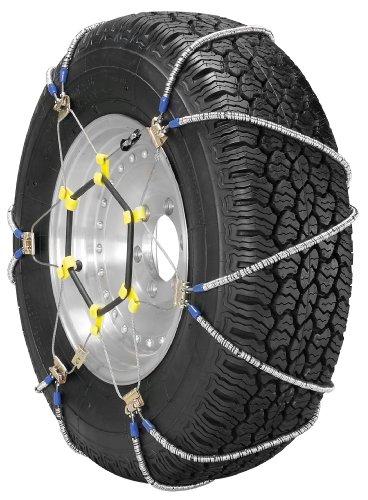
Security Chain Company Super Z LT Light Truck Traction Cables
The Security Chain Company (SCC) Super Z LT line is designed specifically around the tight wheel-well clearances of modern pickups and SUVs.
While traditional truck chains use heavy welded iron links that stand tall off the tread face, the Super Z LT utilizes hardened manganese alloy steel rollers wrapped around flexible steel aircraft cable. This design keeps the dynamic operating profile well within the 15 mm envelope mandated by SAE Class S clearance standards.
These cables are an ideal match for highway drivers who need an emergency traction device stashed under the rear seat to satisfy state highway patrol chain-control checkpoints over mountain passes. The included split-outside cable design allows you to install them without crawling completely underneath the chassis or rolling the truck forward over loose links.
A critical driveway reality check: you must test-fit these cables in your dry driveway on a sunny Saturday before you head into the mountains. Unpack the kit, read the size-matched hook-up points, drape the cables over your drive tires, attach the rubber tensioner bands, and roll the truck forward twenty feet to verify that the rollers seat cleanly in the tire tread grooves. If you wait until you are stranded on a dark, sleet-covered highway shoulder to discover that your tire size requires a different cross-member link adjustment, you will regret it.
Fitment verification note: Check your owner’s manual before installing. Certain modern half-ton trucks (including specific recent model-year Ford F-150 trims) contain manual instructions warning against self-tensioning chain devices; always defer to the specific language printed in your vehicle’s glovebox manual.

Security Chain Company Quik Grip CAM Light Truck Link Chains
When you are dealing with unplowed rural roads, frozen farm fields, or commercial snowplowing routes, low-profile cable devices can spin and wear out.
The SCC Quik Grip CAM series is a traditional ladder-style link chain built from thick carbon steel that crushes through deep, crusty snow and bites directly into frozen gravel and rutted ice.
The integrated CAM tightening system is the standout feature on this setup. Traditional ladder chains require you to buy separate rubber bungee tensioners and struggle with cold fingers to hook them into the side rails. The Quik Grip CAM system builds mechanical eccentric cams right into the perimeter chain. Once you drape the chain over the tire and hook the interior and exterior fasteners, you simply insert the included T-handle cam tool and rotate the cams downward to lock all excess slack out of the assembly.
Because of the thick link profile, you must never install these on trucks with tight suspension clearances. If your pickup has factory 20-inch wheels, aftermarket suspension lifts with custom steering knuckles, or tight upper ball joints, these links can strike your strut bodies or bend brake line brackets under suspension compression. Reserve these chains for trucks with verified clearance (such as stock three-quarter-ton or one-ton platforms running standard commercial tire sizes) and strictly observe our snow chains for 4x4 trucks guide for proper axle placement.
Sandbaggy Heavy-Duty Canvas Sandbags (Pack of 4)
If you drive an empty two-wheel-drive pickup and decide that adding 200 pounds of rear axle weight is the right call for your driveway take-offs, do not just toss flimsy plastic home-improvement sandbags into your bed.
Cold weather makes basic poly woven sandbags brittle; after a couple of weeks of sliding against a ribbed bed liner, those cheap plastic bags crack open, dumping wet sand into your bed drains and tailgate hinges.
These Sandbaggy heavy-duty canvas bags solve that mess completely. Built from a thick, tightly woven commercial canvas, they remain pliable and tear-resistant even when exposed to sub-zero freezes and rough composite bed surfaces. Each bag comfortably holds roughly 50 pounds of dense dry sand, allowing you to fine-tune your ballast weight in predictable 50-pound increments.
To install them properly in your truck bed, place four filled bags (roughly 200 pounds total) directly centered over the rear axle. Do not let them sit loose on a slippery drop-in plastic bed liner. Use a simple 2x6 piece of dimensional lumber dropped into your truck bed’s vertical divider pockets (most Ford, GM, and Ram trucks have these slots molded right into the bed sides), or anchor them across the tie-down rings with a heavy-duty ratchet strap. Securing your ballast ensures the weight stays directly over the axle where it belongs, rather than sliding into the tailgate and upsetting your front-to-rear brake balance.
Common Winter Setup Mistakes That Damage Truck Hardware or Strand You
Over decades of driveway wrenching and winter trail recoveries, we have seen drivers make the same expensive mistakes every winter. Most cold-weather truck mishaps are not caused by blizzards; they are caused by incorrect hardware choices, loose cargo, or improper operating speeds.
| Failure mode | Error | Result | Fix |
|---|---|---|---|
| Overloading the rear axle (tailgate lever) | Stacking 600+ lb of sand against the tailgate | Unloads the steer axle; dangerous understeer | Cap ballast at 100–300 lb and strap it over the axle |
| Loose or unverified chains | Installing without checking clearances | Flailing links hit ABS wiring, brake lines, liners | Test-fit in the driveway; Class S cables if clearance is tight |
| High-speed driving on chains | 45+ mph on pavement with chains on | Thrown cross-links, rapid failure, body damage | Stay at 25–30 mph; pull them off on clear pavement |
Mistake 1: Stacking Heavy Weight Directly Against the Tailgate
The most widespread ballast mistake is pushing several hundred pounds of gravel or sand all the way to the back of the bed against the tailgate. While this does add vertical load to the rear drive tires, it creates an aggressive lever around your rear axle.
By placing heavy mass several feet behind the rear spring perches, you create a teeter-totter effect that physically unloads the front suspension. This robs your front tires of the downward force needed to steer the vehicle and handle front-axle braking. Always position ballast directly centered over, or slightly ahead of, the rear axle centerline, and never exceed 300 pounds in a half-ton pickup.
Mistake 2: Failing to Pre-Fit Chains Before You Need Them
Buying a set of chains off an internet retailer and tossing the unopened box under your rear seat is a recipe for disaster. Tire sizing designations are not completely uniform across manufacturers; an aggressive all-terrain tire with deep shoulder lugs often has a larger actual outer diameter than a highway-rib tire with the exact same metric size stamp.
If you attempt to install your chains for the first time in an unlit highway chain-up area during a blizzard, you may discover the cross chains are two links too short or that your inner wheel-well clearance is completely obstructed by an aftermarket sway bar. Always mount your chains in your dry driveway first, adjust the take-up links to fit your specific tires, and drive a few low-speed circles to confirm clearances.
Mistake 3: Driving on Dry Pavement at High Speeds with Chains Installed
Tire chains and cables are low-speed emergency tools designed strictly for snow pack and sheet ice. State highway departments, vehicle manufacturers, and chain makers all establish a maximum operating speed ceiling of 25 to 30 mph.
If you leave your chains on while driving 45 or 50 mph down plowed or salted highway stretches, centrifugal force causes the side rails and cross cables to expand outward away from the tire tread face. This dynamic ballooning allows the steel links to slap violently against your inner metal fenders, wiring looms, and shocks. Furthermore, running hardened steel cross chains across bare asphalt wears down the contact links rapidly, leading to sudden metal fatigue and severed cross links that whip your painted quarter panels.
Mistake 4: Running Winter Tires Only on the Rear Axle
In an attempt to save money, some truck owners purchase two winter tires and install them exclusively on the rear drive axle of their two-wheel-drive pickups. This creates a severe vehicle dynamics hazard.
When you accelerate, the rear axle grips cleanly. But as soon as you enter a slippery corner or apply the brakes, the front tires—which carry sixty percent of the truck’s weight and perform seventy percent of the braking work—will break traction and slide forward out of control. Winter tires must always be installed as a complete set of four matching tires to ensure balanced handling, predictable steering response, and stable four-wheel braking.
Frequently Asked Questions
Will installing dedicated winter tires void my truck’s factory warranty?
No. Under the federal Magnuson-Moss Warranty Act, an automaker cannot void your entire vehicle warranty simply because you mounted aftermarket or replacement tires. However, the replacement tires must match the size, load index, and speed rating parameters specified on your vehicle’s door placard. If you install an improper tire size or load range that directly causes damage to your differential, transfer case, or suspension components, the dealership can legally deny warranty coverage for that specific repair.
Will using snow chains void my warranty or damage my ABS system?
Chains will not void your overall warranty, but if you install an unapproved chain style that strikes suspension arms, severs flexible brake hoses, or rips out ABS wheel-speed sensor wiring, you are personally liable for those repair bills. Vehicle owner manuals specify exact tire-chain limitations—such as mandating SAE Class S low-profile devices or prohibiting chains entirely on specific large factory wheel sizes. State transportation agencies consistently note that while local laws mandate traction devices, you must operate equipment that physically clears your truck’s chassis hardware.
Do I legally need to carry chains if my truck has four-wheel drive?
Yes, depending on the state and the posted weather alert level. While four-wheel-drive vehicles equipped with qualifying winter or all-terrain tires are often granted exemptions during basic chain warnings (such as California Caltrans R-1 and R-2 levels), many state statutes (including Washington WSDOT rules and California R-2 highway controls) still legally require 4WD vehicles to carry an approved, properly fitted set of chains inside the vehicle. If weather deteriorates to severe conditions (such as California R-3 or full Colorado Chain Law declarations), every single vehicle on the roadway must install chains regardless of drivetrain.
Are standard M+S rated tires legally considered snow tires under state traction laws?
It depends strictly on the state statute. For example, California vehicle code recognizes tires stamped with an M+S marking as acceptable “snow-tread” tires for passenger chain-control checkpoints. However, other states enforce stricter standards; Colorado’s passenger traction law accepts M+S tires only if they have at least 3/16 inch of tread depth, whereas Oregon statutes define qualifying traction tires for specific mountain pass exemptions primarily around the severe-service Three-Peak Mountain Snowflake (3PMSF) standard. Always check the specific Department of Transportation regulations for your travel route.
Will bed ballast work properly in a short-bed pickup truck?
Yes. Bed ballast cares about axle geometry, not total bed floor length. In a short-bed truck (such as a 5.5-foot bed), you still position the weight directly over or slightly ahead of the rear axle centerline. Because short-bed trucks have shorter overall wheelbases, placing ballast too far back against the tailgate causes an even more severe lever effect that unloads front steering traction, so keeping the weight secured squarely over the axle is critical.
Is 200 pounds of sand in the bed really enough to help winter traction?
For a modern half-ton pickup, yes. Adding 100 to 200 pounds on a 4x4, or 200 to 300 pounds on an empty 2WD truck, provides enough vertical load to help the drive tires bite into snow and ice without overburdening your suspension. Adding 500 or 600 pounds is counterproductive: it eats up your payload, increases your vehicle’s stopping distance on ice, and can cause excessive rear suspension sag.
Can I just mount two winter tires on the drive axle to save money?
No. You should never mount winter tires only on one axle of a pickup truck. Running high-grip winter rubber on the rear axle paired with hard all-season tires on the front creates a severe traction mismatch. When braking or turning on cold, slippery surfaces, the front wheels will easily lose lateral grip, causing dangerous understeer that prevents you from steering around obstacles.
What is the maximum safe driving speed when running snow chains or cables?
Thirty miles per hour is the universal ceiling. Vehicle manufacturers, tire chain fabricators like Peerless and SCC, and state transportation agencies (such as Caltrans) all establish maximum operational speeds between 25 and 30 mph when running chains. Driving faster than 30 mph causes centrifugal forces to pull the chains away from the tire tread, leading to severe wheel-well damage, broken cross links, and loss of vehicle control.
Do studded tires eliminate the need to carry snow chains over mountain passes?
No. While studded tires provide outstanding mechanical bite on sheer ice, state transportation agencies (such as Washington State DOT) explicitly clarify that studded tires do not fulfill statutory chain requirements when full chain controls are declared. When an emergency chain requirement is activated on a mountain pass, you must install approved chains or alternative traction devices regardless of whether your tires have metal studs.
Is it better to use water bladder ballast bags or hardware-store sandbags?
Both perform the exact same physical job of adding vertical weight over the axle. Purpose-built baffled water bladders (such as ShurTrax) offer the advantage of contouring flat across the bed floor and draining easily when spring arrives. However, dry sandbags or tube sand remain the most cost-effective solution, provided you buy durable canvas shells that will not crack open in sub-zero freezes and securely strap them over the axle.
Related Winter Guides
Before you head into severe cold, check out our guides covering setup procedures, fitment specs, and payload calculations:
- Best Way to Add Weight to a Truck Bed for Winter: Step-by-step instructions on securing tube sand, building 2x6 bed divider boards, and staying within your truck’s axle ratings.
- Best Snow Chains for 4x4 Trucks: How to select front vs rear chain placement, tension ladder links, and navigate state-by-state winter road regulations.
- How to Choose the Best Tire for Your Pickup Truck: Tire Basics: Load ratings, metric vs flotation sizing, and how tread compounds handle real weight.
- Tire Size and Speedometer Calculator: Calculate speedometer error, overall diameter, and revs per mile when changing winter wheel and tire dimensions.
- Hitch Setup and Tongue Weight Calculator: Calculate available payload and tongue load before adding winter gear or pulling trailers in cold weather.
Reference Sources
- USTMA Tire Information Service Bulletin 37 No. 6: Severe Snow Conditions & 3PMSF Testing
- USTMA Guidelines for Replacing Tires on Light Trucks and Passenger Vehicles
- Peerless Chain Company Limited Clearance & SAE Class S Standards
- California Department of Transportation (Caltrans) Winter Chain Control Guidelines
- Colorado Department of Transportation (CDOT) Passenger Vehicle Traction Law & Chain Rules
- Colorado State Patrol Chain Law Information & Passenger Regulations
- Washington State Department of Transportation (WSDOT) Winter Driving Guide
- Oregon Department of Transportation (ODOT) Minimum Chain and Traction Tire Rules
- Federal Trade Commission / GovInfo Auto Warranties and the Magnuson-Moss Act
- AAA Oregon/Idaho Winter Traction & Tire Safety Guidelines
More Featured Guides

Best Snow Chains for 4x4 Trucks: Fitment, 4WD Placement, and Winter Traction
Choose snow chains for a 4x4 truck by tire size, clearance, chain law, axle placement, and how much snow or ice you actually drive through.
Read Guide
Larger Tires on a Pickup: Recalibrate the Speedo, Regear, or Both?
Bigger tires throw off your speedometer and sap mechanical leverage. Here is how to decide whether your truck needs an ECM recalibration, an axle regear, or both.
Read Guide
How to Charge a Truck Battery With a Charger: Amps, Charge Time, and Dual-Battery Diesels
How to charge a truck battery or parallel diesel setup, calculate recharge time without guessing, and hook up smart chargers without confusing battery monitoring sensors.
Read GuideKelley Crush
Kelley is a mechanical engineer and a truck enthusiast. He's currently an F-250 guy, but he promises to respect any well-equipped and properly utilized truck.