
Best Jump Starters for Diesel Trucks: Amps, Cold Weather, and Safe Picks
The best jump starter for a diesel truck is the one with enough real starting current for your engine, clamps that can reach your battery posts, and a battery chemistry that still makes sense in your climate. Diesel pickups ask more from a booster pack than a small gas car because diesel engines use high compression and often have big batteries, long cables, glow-plug load, cold oil, and larger rotating assemblies.
That does not mean every truck owner needs the biggest pack on the shelf. A weekend 3.0L diesel SUV, a 6.7L work truck parked outside in January, and a fleet service truck all need different tools.
Key Takeaways
- For diesel pickups, treat advertised peak amps as a starting point, not the whole answer.
- A lithium pack is compact and easy to store, but cold weather can reduce its useful output.
- A lead-acid jump box is heavier, but it can be a better fit for repeated use and cold shop duty.
- Do not buy a jump starter to hide a weak truck battery, bad alternator, loose terminal, or parasitic draw.
- Keep the pack charged before trips. A jump starter that lives at 20 percent charge is mostly cargo.
Quick Picks
TruckPowerUp may earn a commission from qualifying purchases. These are research-based product examples, not hands-on test rankings. Check current fitment, engine-size claims, warranty terms, charger requirements, and return policy before buying.
| Pick | Best For | Main Tradeoff |
|---|---|---|
| Clore Jump-N-Carry JNC660 | Heavy lead-acid shop and roadside use | Heavy and less glove-box friendly |
| NOCO Boost Pro GB150 | Premium lithium power for larger diesel pickups | Expensive compared with smaller lithium packs |
| NOCO Boost HD GB70 | Smaller diesel trucks and occasional carry | Less headroom than the GB150 |
| GOOLOO GP4000 | Value lithium option with high advertised peak amps | Verify current listing details carefully |
| DeWalt DXAEJ14 | Combo jump starter and air compressor | Bulky, and the compressor is for convenience, not shop-speed tire service |
Pre-Checks Before You Buy
Start with the truck, not the product listing.
| Check | Why It Matters |
|---|---|
| Battery age | A booster can start a truck once, but it will not fix a battery near end of life |
| Terminal condition | Corrosion and loose clamps can mimic a dead battery |
| Engine size | A 3.0L diesel does not need the same reserve as a 6.7L diesel in cold weather |
| Parking climate | Lithium packs can lose useful output in very cold storage |
| Battery location | Some trucks need long cables or easy access to remote jump posts |
| Use pattern | Fleet, towing, and rural travel justify more reserve than occasional suburban use |
| Recharging habit | Any pack becomes unreliable if it is forgotten between trips |
Why Diesels Need More Jump-Starter Headroom
Diesel engines rely on compression ignition. A typical diesel compression ratio is often in the mid-teens to low-twenties range, far higher than many gasoline engines. That helps explain why a cold diesel pickup can demand serious starting current before it ever lights off.
On a truck, the harder starts usually come from a stack of small problems:
| Problem | What It Does |
|---|---|
| Cold oil | Makes the starter work harder to turn the engine |
| Low battery state | Drops available voltage under load |
| Corroded terminals | Adds resistance right where you need current |
| Weak glow plugs or grid heater | Makes cold combustion harder |
| Short booster cables | Forces awkward clamp placement |
| Undersized booster | Clicks, alarms, or gives one weak attempt |
For a diesel pickup, a compact 400A booster that works fine on a sedan is usually the wrong tool. A useful rule of thumb is to shop in the 1,500A to 3,000A advertised peak range for modern lithium packs, then check the maker’s diesel engine-size rating and real-world cold-weather complaints. For heavy use, lead-acid jump boxes are still relevant because they are simple, serviceable, and built around repeated high-current work.
Peak Amps vs. Cranking Amps
Peak amps are the flashy number on the box. They describe a short burst under favorable conditions. Cranking amps and cold-cranking amps are more useful because they describe current delivery under more demanding conditions, but many portable jump-starter listings do not publish them clearly.
Use peak amps to narrow the field, then look for these details:
| Spec | Why It Matters |
|---|---|
| Diesel engine-size rating | Tells you what the maker believes the pack can handle |
| Cable gauge and clamp quality | Bad clamps waste current and are frustrating on truck batteries |
| Reverse-polarity protection | Helps prevent mistakes when you are tired or working in the dark |
| Low-temperature behavior | Matters if the pack lives in the cab or toolbox all winter |
| Recharge method | USB-C, wall charger, and 12V charging options affect daily usefulness |
| Manual override mode | Useful for very low batteries, but only if you understand the safety risk |
Lead-Acid vs. Lithium Jump Starters
| Type | Best Use | Watch For |
|---|---|---|
| Lead-acid jump box | Shop use, tow rigs, fleet work, cold storage, repeated jumps | Heavy, larger, slower to recharge |
| Lithium jump starter | Glove-box/cab storage, occasional trips, compact emergency kits | Cold sensitivity, shorter cables, inflated peak-amp marketing |
| Jump starter with compressor | Occasional tire top-offs and roadside convenience | Slow inflation and more bulk |
If your truck lives in a heated garage and you want something small behind the rear seat, lithium makes sense. If you keep a booster in a cold work truck, help neighbors often, or want a unit that feels less delicate, a lead-acid box is still worth considering.
Clore Jump-N-Carry JNC660
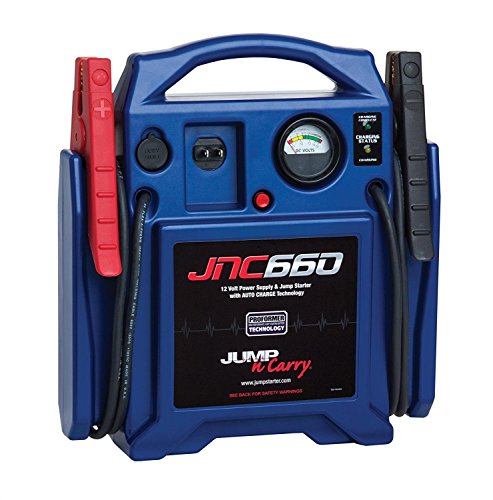
Clore Jump-N-Carry JNC660
- • Lead-acid jump starter
- • 12V
- • 1,700 peak amps advertised
- • Built for repeated jump-start work
The JNC660 is the old-school choice here: big handle, lead-acid battery, heavy case, long cables, and a layout built more like shop equipment than a pocket power bank. It is the one to consider if you value reliability and repeated use more than compact storage.
It is not the easiest pack to keep in a crowded cab, and you will notice the weight. The tradeoff is that a full-size jump box is usually more confidence-inspiring when a truck is cold, parked awkwardly, or being jumped more than once.
NOCO Boost Pro GB150

NOCO Boost Pro GB150
- • Lithium jump starter
- • 12V
- • 3,000A advertised rating
- • Up to 7.0L diesel rating from NOCO
NOCO lists the GB150 as a 3,000A lithium jump starter for gas engines up to 9.0L and diesel engines up to 7.0L. That puts it in the right conversation for larger diesel pickups, especially if you want a compact pack instead of a full lead-acid jump box.
The GB150 is the premium lithium pick because it has more headroom than the smaller GB70, an integrated voltmeter, a bright work light, and a rugged case. The obvious downside is price. If your diesel is smaller or your truck rarely sees serious cold, the GB70 may be enough.
NOCO Boost HD GB70

NOCO Boost HD GB70
- • Lithium jump starter
- • 12V
- • 2,000A advertised rating
- • Smaller and less expensive than GB150
The GB70 is the lighter NOCO option for owners who want a serious lithium pack but do not need the full GB150. It is a better match for smaller diesel trucks, gas trucks, SUVs, and mixed household use.
The reason to skip it is simple: reserve. If you own a full-size diesel pickup, park outside in freezing weather, or want a pack that can help other stranded trucks, step up to the GB150 or a lead-acid box.
GOOLOO GP4000

GOOLOO GP4000 4000A Jump Starter
- • 4000A peak lithium jump starter
- • 12V vehicles
- • Advertised for all gas engines and diesel engines up to 10.0L
- • USB quick-charge and USB-C power-bank ports
The GP4000 is the value-style lithium pick for buyers comparing high advertised output against a lower price. It is the kind of pack that makes sense for a truck emergency kit when you want more muscle than an entry-level booster but do not want to pay NOCO GB150 money.
Verify the exact listing before buying. GP-series names, bundles, cable styles, and charger accessories can change, and a high peak-amp number is not the same thing as proven cold-weather diesel performance.
DeWalt DXAEJ14
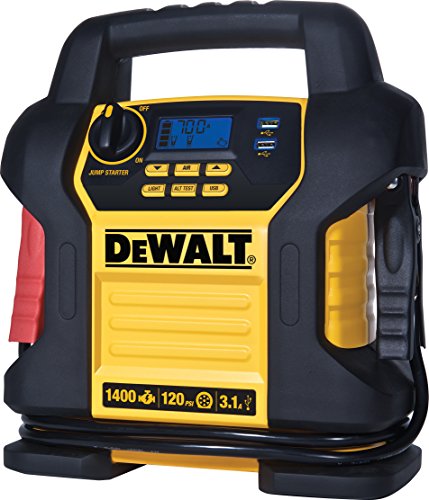
DeWalt DXAEJ14
- • Portable power station style jump starter
- • Built-in air compressor
- • Useful for roadside kits
- • Bulkier than lithium-only packs
The DXAEJ14 is here for a different buyer: someone who wants one roadside unit that can jump a battery and add air to a low tire. That can be handy for a work truck, camping rig, or older pickup that already carries recovery gear.
Do not buy it expecting a fast shop compressor. Combo units are convenient, not magical. If your main problem is a diesel that needs maximum starting current in the cold, a dedicated jump starter is a cleaner choice.
How Many Amps To Jumpstart A Truck
The old rule that a diesel truck needs at least 800 peak amps is too soft for today’s product listings. Many modern lithium jump starters advertise 1,500A, 2,000A, 3,000A, or more. That does not mean every 3,000A pack performs the same, but it does mean a full-size diesel owner should not shop at the bottom of the category.
For a practical diesel pickup shortlist:
| Truck Situation | Sensible Starting Point |
|---|---|
| Small diesel SUV or midsize diesel | Quality lithium pack with published diesel rating |
| Half-ton diesel or light-duty diesel pickup | 1,500A to 2,000A lithium class, with cold-weather margin |
| 3/4-ton or 1-ton diesel pickup | 2,000A to 3,000A lithium class or heavy lead-acid jump box |
| Fleet/shop/repeated jump use | Lead-acid jump box or commercial-grade booster |
Use the jump starter’s engine-size rating as a sanity check, then give yourself more margin if the truck sits outside, has high accessory draw, or often starts in freezing weather.
How To Charge A Jump Starter Pack
The short version: charge the pack before you need it, recharge it after use, and do not assume the factory charge is enough for a winter trip.
Most portable jump starters charge one of three ways:
| Charging Method | Best Use |
|---|---|
| Wall charger or USB-C | Best routine charging method at home |
| 12V vehicle outlet | Helpful during travel if the pack supports it |
| Solar panel | Emergency-only convenience, usually slow and weather-dependent |
Common maintenance habits:
- Fully charge a new jump starter before putting it in the truck.
- Top it off before road trips, towing weekends, hunting trips, or winter storms.
- Recharge it after every jump-start attempt.
- Check stored packs every one to three months unless the manual says otherwise.
- Do not leave a lithium pack baking on the dash or freezing in a bed toolbox all season if the manual warns against it.
If a pack will not charge, check the cable, outlet, power switch, charging port, and manual before assuming the internal battery is dead. If the case is swollen, leaking, cracked, hot, or smells burnt, stop using it.
Safe Jump-Starting Steps
Follow your truck manual and the jump starter manual first. This is the normal flow for a 12V truck battery:
- Put the truck in park, set the parking brake, and turn off accessories.
- Confirm the booster is charged and rated for your battery type.
- Connect red to positive.
- Connect black to the recommended ground point or negative post, as directed by the manual.
- Turn the booster on.
- Try a short start attempt.
- If the truck starts, turn off the booster and remove black first, then red.
- Let the truck run long enough to recover, then diagnose why the battery was low.
When To Skip Buying One
Skip the purchase for now if the truck has obvious battery-terminal corrosion, a failing alternator, a parasitic drain, or a battery that already fails a load test. Fixing the actual electrical problem is money better spent.
Also skip the biggest premium lithium pack if your use case is a small gas car, a garage-kept midsize truck, or a vehicle covered by reliable roadside assistance. A smaller pack may be enough.
More Featured Guides

Best 120V Electric Garage Heaters: Spot Heat, Circuit Limits, and Safe Picks
A practical 120V electric garage heater guide covering 1500W limits, 15A circuits, spot heating, infrared vs fan-forced heat, safety checks, and product examples.
Read Guide
Best Truck Wax: Durable Protection, Ceramic Sprays, and Black-Paint Options
A practical truck wax guide covering prep, carnauba vs ceramic sprays, winter durability, black paint swirl masking, and researched product examples.
Read Guide
Best Truck Bed Tents for Pickup Camping: Fitment, Weather, and Mattress Guide
Choose a truck bed tent by bed length, floor design, weather protection, mattress fit, and tonneau cover compatibility before comparing product names.
Read GuideKelley Crush
Kelley is a mechanical engineer and a truck enthusiast. He's currently an F-250 guy, but he promises to respect any well-equipped and properly utilized truck.