
Best 120V Electric Garage Heaters: Spot Heat, Circuit Limits, and Safe Picks
The best 120V electric garage heater is usually a spot heater, not a whole-garage heating system. A normal plug-in heater tops out around 1,500 watts. That is roughly 5,120 BTU per hour, which can warm your hands, legs, bench area, or one bay in a reasonably insulated garage. It will not turn a large uninsulated shop into a cozy room in January.
That limitation is not a flaw. It is the point. A 120V heater is useful when you want to work near the truck, warm a small bench area, take the edge off a one-car garage, or add temporary comfort without hiring an electrician for a 240V circuit.
Key Takeaways
- A 1,500W 120V heater draws about 12.5 amps, so it can nearly fill a 15A circuit by itself.
- Use 120V heaters for spot heating or small insulated garages, not large drafty shops.
- Plug portable heaters directly into a wall outlet, not a power strip or household extension cord.
- Fan-forced heaters warm air around your work area; infrared heaters warm people and objects in their line of sight.
- If you need to heat a two-car detached garage all winter, compare properly installed 240V electric or gas heat instead.
Quick Picks
TruckPowerUp may earn a commission from qualifying purchases. These are research-based product examples, not hands-on test rankings. Check the current listing, safety certifications, manual, and return policy before buying.
| Pick | Best For | Main Tradeoff |
|---|---|---|
| Patton PUH680-N-U Utility Heater | Rugged portable fan-forced spot heat | Availability varies, and it will not heat a big garage |
| Comfort Zone CZ798 Milk-House Heater | Budget utility heater for near-bench warmth | Basic controls and modest output |
| Shinic QGW15-602 Quartz Heater | Radiant warmth aimed at a work area | Warms the target, not the whole room |
| Dr. Infrared Heater DR-978 | Indoor-style hybrid heater for cleaner garage spaces | Floor placement is less ideal around dust and shop work |
Pre-Checks Before You Buy
Do this before choosing a heater:
| Check | Why It Matters |
|---|---|
| Circuit size | A 1,500W heater draws about 12.5A, leaving little headroom on a 15A circuit |
| Other loads | Battery chargers, compressors, lights, and power tools can trip the same circuit |
| Insulation | Drafty doors, bare concrete, and exposed rafters make a 120V heater feel weak |
| Moisture | Avoid damp locations, puddles, snowmelt, and wet extension setups |
| Dust and chemicals | Keep heaters away from sawdust, fuel, solvents, paint, oily rags, and cardboard |
| Placement | Portable heaters need a flat, stable, nonflammable surface with clearance |
| Use case | Warming your hands at a bench is different from heating a two-car garage |
Safety guidance from fire-safety groups is consistent: keep space heaters away from combustibles, use them only where they can sit securely, and plug high-wattage heaters directly into a wall outlet rather than a power strip or ordinary extension cord: NFPA heating safety resources. The common clearance rule is at least 3 feet from flammable material.
Patton PUH680-N-U Utility Heater

Patton PUH680-N-U Utility Heater
- • Portable utility heater
- • 120V plug-in class
- • Fan-forced spot heat
- • Useful near a bench or one side of the truck
Best for: truck owners who want a rugged portable heater near a bench, work stool, or one side of the truck.
Why it makes sense: This kind of heater is the practical 120V garage option for many people. A metal utility-style fan heater is easier to move around than a wall unit, and it can aim warmth where you are actually working.
What to know: This is still a 120V heater. At the high setting, expect spot heat, not a full-shop temperature swing. It makes the most sense in a small garage with the door closed, some insulation, and a clear place to put the heater.
Watch-outs: Keep it out of walking paths and away from sawdust, cardboard, fuel, solvents, and oily rags. Do not run it unattended while you leave the garage.
Comfort Zone CZ798BK Milk-House Heater

Comfort Zone CZ798BK Milk-House Heater
- • Portable milk-house utility heater
- • 1,500W class
- • Fan-forced heat with low, high, and fan-only settings
- • Adjustable rotary thermostat, tip-over switch, and overheat protection
Best for: budget-minded spot heat near a workbench, tool cart, or small one-car garage workspace.
Why it makes sense: A milk-house style heater is simple: metal cabinet, handle, fan, heating element, and basic controls. That simplicity is useful in a garage where you may want to move the heat from the truck door to the bench and back again.
What to know: The wattage ceiling is the same as other plug-in heaters. If you are cold because the garage leaks air through the overhead door, insulation and weatherstripping may help more than buying a second heater.
Watch-outs: Treat it like a high-draw appliance. Plug it directly into a suitable wall outlet and avoid sharing the circuit with tools that cycle on and off.
Shinic QGW15-602 Ceiling Mounted Quartz Heater
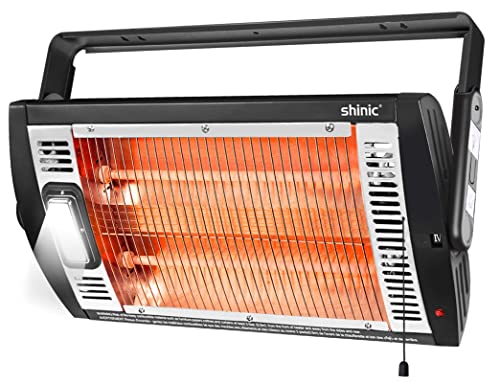
Shinic QGW15-602 Ceiling Mounted Quartz Heater
- • Ceiling-mounted radiant quartz heater
- • 120V plug-in class
- • 750W and 1,500W heat settings
- • Built-in halogen light and pull-string controls
Best for: warming a specific work area from above, keeping floor space clear while aiming radiant heat at your body or bench.
Why it makes sense: Ceiling-mounted infrared quartz heaters warm people and objects directly in their line of sight rather than trying to heat the surrounding air. This is especially helpful in drafty garages where warm air would otherwise escape.
What to know: The heater includes an integrated halogen lamp that can be operated independently or alongside the heating elements. It uses simple pull-string switches to cycle through the light and heat settings, making it convenient when hung overhead.
Watch-outs: The unit must be mounted securely to a ceiling joist using the included mounting chain and hooks. Keep at least 3 feet of clearance between the heater and any combustible materials like shelves, tools, or vehicles.
Dr. Infrared Heater DR-978

Dr. Infrared Heater DR-978
- • Portable hybrid heater
- • 1500W class
- • Infrared plus PTC-style heating concept
- • Thermostat, remote, and timer style feature set
Best for: cleaner attached garages, mudrooms, hobby corners, or basement-adjacent workspaces where comfort matters more than rugged shop abuse.
Why it makes sense: The DR-978 style of heater is more room-like than jobsite-like. The appeal is controlled comfort: thermostat, timer, remote-style convenience, and a mix of radiant and fan-assisted heat.
What to know: Nice controls do not change the electrical limit. At 1,500W, it still draws about 12.5A. It also needs clean airflow, so avoid placing it where grinding dust, pet hair, sawdust, or road grit can collect around the intake.
Watch-outs: Floor heaters are easy to kick, cover, or crowd in a garage. Use this only where it has stable placement and enough clearance.
Why 120V Garage Heaters Feel Small
Electric resistance heat converts watts into heat predictably:
| Heater Rating | Approximate Current At 120V | Approximate BTU/hr |
|---|---|---|
| 750W | 6.25A | 2,560 BTU/hr |
| 1,000W | 8.3A | 3,412 BTU/hr |
| 1,500W | 12.5A | 5,120 BTU/hr |
That 1,500W number is the practical ceiling for most plug-in space heaters. It is enough to improve a small work zone. It is not enough to overcome a large uninsulated garage with an icy slab, gaps around the door, and outside air leaking through every edge.
If you want whole-garage heat, start with insulation, door seals, and air sealing. Then compare a dedicated 240V electric heater or a properly installed gas heater.
Fan-Forced vs. Infrared
Fan-forced heaters blow air across a heating element. They are useful when you want warmer air around your bench, stool, or one bay of the garage. They also stir dust, which matters if you sand, grind, or do woodwork.
Infrared or quartz heaters warm surfaces and people in the beam. They can feel good fast, especially when aimed at your hands or torso. They are less effective if you move around constantly or need to warm the entire air volume.
For truck work, fan-forced heat is often easier near the floor or bench. For a fixed workbench, a properly mounted radiant heater can be more pleasant.
When To Skip 120V
Skip a plug-in 120V heater if:
| Situation | Better Direction |
|---|---|
| Two-car detached garage with little insulation | Insulate first, then consider 240V or gas heat |
| You need heat while using a compressor and power tools | Dedicated circuit or installed heater |
| The only outlet is old, loose, or shared with many loads | Electrical repair before heater shopping |
| The garage has puddles, snowmelt, or wet floors | Fix moisture and outlet safety first |
| You want unattended overnight freeze protection | Use equipment designed and installed for that purpose |
Safety Checklist
Before turning on a portable heater:
| Check | What To Do |
|---|---|
| Outlet | Use a tight, undamaged wall outlet |
| Cord | Do not run the cord under rugs, tires, tool carts, or sharp edges |
| Clearance | Keep at least 3 feet from combustibles |
| Surface | Place portable units on a hard, stable, nonflammable surface |
| Fuel and chemicals | Keep away from gasoline, solvents, paint, oily rags, and aerosol cans |
| Supervision | Turn it off when you leave the garage |
| Smoke alarm | Make sure nearby smoke alarms work |
If the plug, outlet, or cord feels hot, stop using the heater and inspect the circuit before trying again.
FAQ
Can a 120V heater warm a garage?
It can warm a small insulated garage or a work zone. It usually cannot heat a large uninsulated garage comfortably. Think spot heat first.
How many amps does a 1500W garage heater use?
About 12.5 amps at 120 volts. That is why running tools or chargers on the same 15A circuit can trip the breaker.
Is a 240V garage heater better?
For whole-garage heat, usually yes. A dedicated 240V heater can deliver much more heat, but it needs proper wiring, breaker sizing, installation, and clearance.
Are infrared heaters better than fan-forced heaters?
Neither is always better. Infrared feels fast when aimed at you. Fan-forced heat is better when you want warmer air around a small work area.
Can I use an extension cord with a garage heater?
Avoid it. High-wattage heaters should be plugged directly into a wall outlet unless the manufacturer allows a specific cord type and an electrician confirms the setup is safe.
More Featured Guides

Best Jump Starters for Diesel Trucks: Amps, Cold Weather, and Safe Picks
A practical diesel jump starter guide covering peak amps, cranking amps, lithium vs lead-acid packs, charging habits, and researched product examples for pickup owners.
Read Guide
Best Truck Wax: Durable Protection, Ceramic Sprays, and Black-Paint Options
A practical truck wax guide covering prep, carnauba vs ceramic sprays, winter durability, black paint swirl masking, and researched product examples.
Read Guide
Best Truck Bed Tents for Pickup Camping: Fitment, Weather, and Mattress Guide
Choose a truck bed tent by bed length, floor design, weather protection, mattress fit, and tonneau cover compatibility before comparing product names.
Read GuideKelley Crush
Kelley is a mechanical engineer and a truck enthusiast. He's currently an F-250 guy, but he promises to respect any well-equipped and properly utilized truck.